Saturday, August 15, 2009

Nixon (1995)


By Eric Jessen 8/14/09

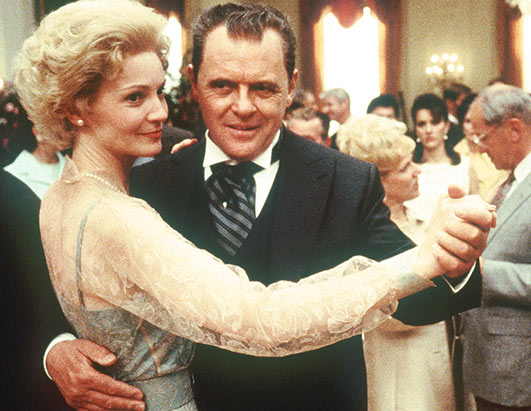
Nixon is a captivating epic muddle of conspiracy theories and the “beast,” a huge biopic of Nixon and the victims of his presidential scandals, battered faces and tortured souls played by an extraordinary cast. Nixon is also a distinctly personal tragedy, a mix of Macbeth and Kane playing out in Oliver's universe, “Citizen Stone.”
Stone's is a complex, frightening movie world, a treacherous “beast” with wars fought in wild, angry jungles (remember Oliver Stone's Platoon), TV News and Animal Planet porn destroying innocent teenage minds (remember Natural Born Killers), a ferociously competitive financial market (remember Wall Street and Michael Douglas saying “greed is good”) and a corrupt political system of communists and assassinations (remember JFK and the magic bullet). “Citizen Stone” is Oliver's paranoid delusional nightmare. He tickles our fancy for borderline absurd conspiracy theories, dazzling, awesomely thrilling while also vindictive and menacing, deeply personal, begrudging, stubborn, and desperate to be controversial. It's uniquely Oliver. With Nixon he's found a perfect playmate, the ideal antihero, awkward loser. Oliver's Nixon played by Anthony Hopkins is a strange complicated mess of emotions and Freudian psycho-drama: his blessed mother, father's “woodshed,” and two brothers' deaths lurk over his shoulders. They share a “me against the world,” spit in the face of the east coast elite mentality, a bitterness and hatred for the establishment.
In Nixon Oliver Stone also invokes basic Shakespearian tragedy and Wellesian Kane. This Nixon has a tragic flaw and a “rosebud,” smoking gun, hidden secret. The film is set during the last few months of Nixon's presidency as he drinks, pops pain pills and completely unravels. Hunched over in the Lincoln room, Nixon listens to the infamous Watergate tapes and remembers his life.
We watch, through flashbacks, Nixon's rough childhood, his rocky political life of embarrassments and a building jealous hatred for JFK and the Kennedys. Oliver Stone paints Nixon as a man in constant struggle, a victim of the “beast,” the political environment, his childhood, the pressure to succeed, but also a victim of his own insecurity. He was ugly, poor, awkward, and desperate to be loved, drawing more and more inward as he was rejected, never letting himself be vulnerable. So he became a tireless worker, a bull of a fighter, battling his way to the top. But as the public rejected him he became more and more bitter which only fueled his crotchety, corrupt villain persona. He realizes his self fulfilling prophecy: “Others may hate you. But those who hate you don't win unless you hate them. And then you destroy yourself.” Nixon despised JFK because he saw in him everything he wanted to be: rich, attractive, personable and loved. He says in front of JFK's portrait in the White House, “When they look at you they see what they want to be. When they look at me they see what they are.”
Oliver Stone portrays Nixon as a complicated human being instead of a caricature. He also captures the mystery in Nixon. In the “Citizen Stone” world, Nixon is also a fascinating, Kane-esque enigma, always seeming to be holding back a deep dark “something.” He's a black hole of emotions but a treasure chest of juicy secrets. Maybe the 18 ½ minutes of missing tape hold the answers.
Nixon is as much about Oliver Stone as anything but he surely doesn't deserve all the credit. Though he doesn't look or sound like Nixon, Anthony Hopkins does a fantastic job of depicting Nixon's internal pain and suffering, his tension but also his enormous presence. Nixon also includes a marvelous supporting cast. Joan Allen as Pat Nixon, James Woods and J. T. Walsh as Halderman and Ehrlichman, Paul Sorvino as Henry Kissinger, Bob Hoskins as J. Edgar Hoover, and Powers Boothe as Alexander Haig are all spectacular. And Robert Richardson's photography is beautiful.
Nixon is now a fascinating, tragic enigma, a tortured soul in my mind and never again merely a crotchety, corrupt villain.

Thursday, August 13, 2009

Detective Story (1951)


By Eric Jessen 8/12/09

“Never mind a doctor, get a priest.” Detective Story has a foul, rotten milk, stewing in the fridge, chunky and yellow, grimy aroma: first setting me back in my chair, cringing, then only tingling my nostrils. Its squalid B-Movie cop melodrama reeks of a rank stale cheese passion: everyone has a rap-sheet, there are criminals, tramps, and officers bemoaning the “crummy system.” The sizzling misanthropic stench and gamy taste simmers and spoils but eventually becomes interesting tart.
The movie has a scrapping, clawing, tearing up dirt method, searching desperately for significance and barely breaking the surface, but making for an exorbitant romp.
Detective Jim McLeod's (Kirk Douglas) demons are drudged up during the course of one raucous day at the precinct. McLeod is a bloated stiff, his belt tightened to puff up his chest (a perfect Douglas role). He fancies himself a one man street sweeper, ridding the big NYC of crooks, sticking to his principles, never letting anyone off the hook. He huffs and puffs, steam shoots out of his ears, he stomps around, pounds his fists on his desk at work and then heads home to his “immaculate wife” who is blonde, thin, gorgeous, and saintly (Eleanor Parker).
But underneath McLeod has untold fears. And when he discovers that his untouchable wife has a shady past that includes premarital sex and abortion, his craggy exterior begins to crack and clichés burst out of his seams, cluttering up the Styrofoam, cardboard, blatantly fake set. William Wyler ramps up the ridiculous and Douglas leads gaudy, but absorbing tangy cheese acting. We learn McLeod had one bad case, “when he was just a rookie.” His father was a “hardass.” His tough bravado is only for show, to hide his inner torment. McLeod pulls his hair out, envisioning his wife with another man, threatening to kill himself and saying with a creepy seriousness, “I'd give my soul to take out my brain, hold it under the faucet and wash away the dirty pictures.”
As much as Detective Story stinks it has zesty bellowing exuberance. And within the cloud of odor, Douglas' relentless yelling and the look and feel of overwrought cheapness, I think director William Wyler stumbled upon the patch job of an actual character. McLeod dreads a murky world and lack of control so he neatly packs everything into black and white, good and evil terms but as the movie warns, he is only “digging his own grave” of disappointment.
So I admire, or at least value Detective Story. It doesn't pack things together nicely, it scrapes together flames of overripe passion, lets emotions run wild and the result is an exhilarating, if sometimes disagreeable or laughable, experience.

Wednesday, August 12, 2009

The Blue Angel (1930)


By Eric Jessen 8/11/09

The Blue Angel is combination of silent expressionism - stacked pointy houses (reminiscent of The Cabinet of Dr. Caligari), dim street corners, every frame suffocated by darkness grasping for light, featuring Emil Jannings (of F.W. Murnau's The Last Laugh and Faust's fame) - and a Josef Von Sternberg, Marlene Dietrich (of Shanghai Express and The Scarlet Empress) sensuous, sultry, libidinous talkie. One star emerged and the other had his final hurrah. Emil Jannings got top billing, the silent German film star famous for an overacting lively visage, brooding, mournful as the sad sack in The Last Laugh. But Marlene Dietrich with just one sarcastic, baiting glance, strutting around in her panties singing “Falling in Love Again” stole the show.
Jannings plays Emmanuel Rath, a craggy college professor: sour, abrupt and authoritative. He cracks the whip on his rowdy students with a sadomasochists' delight. When he learns from his teacher's pet that his students spend their nights enjoying a peep show at The Blue Angel, he charges down to the Vaudevillian club to confront them. Rath wades through a nylon sheath and a fog of smoke to arise in the dressing room where he meets Lola Lola (Marlene Dietrich). Her casual fleshiness and smoldering voice scream raunchy depraved sex (without love or commitment). She prances around the room, toys with the professor, showing a leg, pouting then bubbling (like Louise Brooks in Pandora's Box) with a mocking callous but playful tone. She effortlessly breaks his rough exterior and he immediately becomes her lap dog. Rath and Lola Lola get married, which seems somewhat implausible although at a few moments Lola shows signs of compassion for Rath. He reluctantly starts traveling with the bawdy show and eventually is peddling lewd pictures of his wife and getting dressed in full clown costume having eggs cracked over his head. Rath mopes and stays silent as he watches his wife sexually taunt and humiliate him, absorbing sorrow and pain, forever trapped under the Dietrich spell (reminding me of the torturous ending to “Caligari”).
In The Blue Angel I witnessed the perfect combination of two remarkable landmarks. Marlene Dietrich burst onto the screen as tempting and marvelous as ever and her salacious voice (in an English or German version) for the first time tantalized the ear. She and Josef Von Sternberg were beginning to master their craft. And at the same time I was pleased to see Emil Jannings make one last expressive silent sad face.

Tuesday, August 11, 2009

Young Mr. Lincoln (1939)


By Eric Jessen 8/10/09

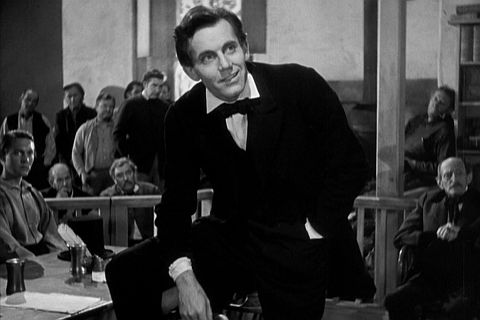
As a result of my movie temperament being warped by the current slam bang brand of cinema, at least two boobs and a punch in the face per 30 minutes (I'm still recovering from Natural Born Killers), my first impression of Young Mr. Lincoln and most John Ford movies is that they are dragging blah. Young Mr. Lincoln's astute patience and even delivery plays flat and artless. The overly folksy “Lincoln” is commercial Americana, like bland campaign propaganda: Henry Fonda in full make-up, suit and top hat chops wood, eats pie, plays a Jew's Harp and tells stories of cattle and “the cabin” to overall-wearing, straw-chewing midwesterners. But with multiple viewings or careful consideration a John Ford film slowly penetrates the psyche (I found myself fervidly arguing that Abe Lincoln is the greatest U. S. President in history), splitting my depraved sensibilities with its saintly, calm naturalism. Its depth becomes apparent.
Although Henry Fonda (not a favorite actor of mine) once again tilts his head and looks to the skies with a pious self-assurance like a deity, never engaging the audience, in this case he's perfect as legendary hero President Lincoln. At the same time his overpowering goodness and morality are thankfully not shoved in our face to the point of being nauseating. Fonda as Lincoln has a blind confidence and sense of reason. His witty remarks and down home chats are refreshing, making him a ideal trustworthy politician.
The skill in Ford's direction and Fonda's acting is in creating a noble but nuanced figure. Watch closely Lincoln's awkwardness around women and Illinois bourgeoisie. At heart he is just a bashful country boy with a bumpkin attitude masking a religious mentality and inherent wisdom, speaking the honest truth with the utmost clarity (at one point to soften an angry mob). Watch closely for the appearance of fear and indecision when he is alone with his thoughts by the river. He seems distressed as if he is shouldering a great burden. In the final scene when a lovable drunkard asks him “ain't you comin' Abe?” Lincoln replies, “No, I think I'll go on to the top of that hill,” (not as cheesy as it sounds).
Young Mr. Lincoln may often seem overly simplistic in portraying democracy and mid 1800's America. At times it may seem boring. But even if you've been forever jaded by the sexploitive, bloody macho porn of CGI infested, washed out 3D and IMAX modern cinema, take some time to think, watch “Lincoln” again, watch The Searchers, My Darling Clementine and all of John Fords films again, because they're subtle, enduring and sublime.

Sunday, August 9, 2009

Major Dundee (1965)


By Eric Jessen 8/8/09

Major Dundee is a fascinating cluttered disaster of drunken Sam Peckinpah. Columbia Pictures and Charlton Heston loved Ride the High Country (1962), Peckinpah's first film, and decided to lump a sizable budget, a Harry Fink script, and a feeling of flexibility on the shoulders of the tormented genius. The boozing, coarse director ventured south to a remote dusty Mexican hole, threw the original script in the trash and began shooting, shifting the movie's focus to a morose character study of Major Dundee (Charlton Heston). But as the spending skyrocketed and rumblings of Peckinpah infuriating, torturing the cast, and being too wasted to direct emerged, Columbia cut funding in half. The production rushed to an awkward finish. The released studio version got negative reviews and flopped at the box office. But in a cloud of studio cuts and production turbulence, Major Dundee is still full of bits of classic Peckinpah and is an interesting representation of the director's career.
The movie begins at the sight of a massacre of Union soldiers, women and children by Apache Indians. Major Dundee, the goat of the Union's loss at the Battle of Gettysburg, exiled to the Mexican border, decides to put together a troupe of soldiers and confederate prisoners, including his former best friend and rival, Captain Tyreen (Richard Harris) to hunt down the Indians.
The early passages of the movie run smoothly but painstakingly slow, progressing like an epic (I've read Peckinpah's original cut was over 4 hours long). Dundee and Tyreen pussyfoot around, conversing intently, their lines crawling from their mouths then floating above their heads clearly indicating “to be referenced later,” before they decide to “ride together.” The first few scenes are boring and bloated, the soldiers singing rah-rah songs, but hint at a meaningful payoff (like the overly happy scenes in The Big Heat).
Dundee, Tyreen and company head down to the expansive Mexican wilderness (photographed very well by Sam Leavitt) setting up patented Peckinpah themes: the macho brotherhood of battered men and their “sacred word.”
Dundee is at first trimmed (Heston's chin lathered in aftershave) and confident, seeking glory, but suppressing the feeling of impotency and heading into a dangerous jungle. Dundee seems to be shaping into a compelling character. Charlton Heston's bullheaded machismo and Richard Harris' effeminate British demeanor make for an interesting love affair. And I also found it intriguing that the American soldiers, armed with guns and cannons would struggle to defeat the Indians' bows, arrows and intimate knowledge of the terrain.
But as the film entered its second hour it became increasingly choppy and uncomfortable to watch. Lines from Heston, Harris and the supporting cast fall on dead air (like I'm missing key information, a scene or two, lost in a cut maybe). The action scenes are jerky (definitely not Peckinpah). And worst of all there are 20 to 30 minutes of a hapless love interest. Dundee meets a woman in Mexico, Teresa, played by Senta Berger. She is dull and mundane. Her scenes are painful to watch. I don't think you can call what Berger does acting. She just exists with no personality and big breasts.
With Sam Peckinpah plastered, well off the wagon, working for an apprehensive studio, Major Dundee was destined for failure. Peckinpah would just have to wait to make his drunken masterpiece.

Friday, August 7, 2009

I Heart Huckabees (2004)


By Eric Jessen 8/609

I Heart Huckabees is bawdy slapstick and unrelenting farce mixed with entry level existentialism. It's full of wacky, hilarious little bits like when Lily Tomlin asks Jason Schwartzman, “Have you ever transcended time and space?” and he responds “Yes. No. Time not space. No I don't know what your talking about.” I Heart Huckabees throws philosophical gibberish about “the big everything” and “everything is the same even if it's different” against the wall hoping they stick but fortunately never taking any of it seriously. It's like watching the Three Stooges or the Marx brothers babble Nietzsche. The balloon to the face, muddy sex, stupefying comedy made me laugh and chuckle but left me mostly bewildered (sometimes I scrunched my lip and brow in a “whatchu talkin' bout Willis” facial expression).
The story progresses like a mad sprint, hard to follow, full of holes, leaving the details and the ideas in the dust ending with a celebratory “I don't get it” and all the pretty couples united. Describing it will take a first class effort on my part.
Okay.....there's this guy, Albert (Jason Schwartzman), who is an environmentalist, or at least he talks a lot about saving a marsh and he once planted a tree in the middle of a parking lot. He's also a poet and a sentimental fool writing about his favorite rock with the timeless line “you rock. Rock.” He is confused, very confused and semi-seriously frustrated. So he goes to see the “Existential Detectives” because......he's depressed, confused, frustrated? No. Because he wonders about these coincidences in his life, that involve a tall African doorman and a Jessica Lange photograph and he wants to know what it all means.
Detectives Bernard (Dustin Hoffman) and Vivian (Lily Tomlin) are hired, pro bono, to do a full scale, 24-hour study of Albert's “crisis”. They do complete surveillance (“even in the bathroom”) and wiretapping. They follow him around, hide conspicuously in bushes or outside windows, peeking at Albert, taking notes, looking silly. The ultimate reward, so they say, is deep, trippy total self awareness where “everything you could ever want or be you have and are,” and things magically come apart in little 2D squares, relieving you of stress and the feeling of responsibility. And I guess then, for Albert, happiness.
As the investigation begins Albert starts to unravel, tearing apart the world and his arch nemesis Brad Stand (Jude Law) with a machete while in his happy place. Bernard and Vivian decide to introduce Albert to his existential support group buddy, Tommy (played very well by Mark Wahlberg), so they'll both have a breakthrough. Tommy is struggling with the temptation of the dark side, nihilism, where everything is nothing, and nothing matters. The rest of the movie is a strange journey of weird humor and a shouting match between nihilism and existentialism in an effort to get Albert to reach “who cares” bliss.
I Heart Huckabees has philosophical ramblings with little depth and base level humor but a wonderful air of whimsy. When I think of I Heart Huckabees I have a brain freeze. There's an infinite void of confusion, and all I can remember from watching were my many laughs.

Thursday, August 6, 2009

Natural Born Killers (1994)


By Eric Jessen 8/5/09

Natural Born Killers is a religious experience for psychopaths and an angry rant against the TV generation. It's a twisted sitcom, a demented Robert Crumb cartoon, a pulp novel, a trashy newspaper and an acid trip. Oliver Stone's direction - hand held restless, gyrating camera, jumping quick cuts, black and white and color, tilted weird angles, fish-eye distorted curvy lenses, hip music, a river of blood, guns blazing, - is like a Quentin Tarantino movie on crack (I wasn't surprised to learn Tarantino wrote the story but not the script). It's every horrifying, gut wrenching, sex and violence exploitation scene stylized and put to Dr. Dre's smoothest beats and the banging of Nine Inch Nails. It's an unbelievable experience. It's a relentless assault on the eyes, like a thousand punches to the face, enough titillating elements to make you want to hurl. I felt myself sinking, lower and lower, feeling more and more empty as my senses were endlessly rampaged. It's a truly unnerving, dehumanizing feeling.
In Natural Born Killers Oliver Stone satirizes our world of the OJ Simpson trial and Ted Bundy. He pronounces every warped TV junkie child of Generation X a demon born for destruction, sick and deranged from watching Discovery Channel animal humping, ratings obsessed news, wars, and Kung Fu, westerns, and action movies (especially the ending of The Wild Bunch). Everyone is a killer or a corpse, crying inside, popping “E” and smoking weed, high on slam bang TV, blurting music lyrics, sitcom platitudes and reciting movie lines. Charles Manson is our “king.” It's a horrible scary wild hell.
Natural Born Killers is a million crazy things thrown into one. But at its heart it's a 1990's, shot gun wielding, frenzied, insane, perverted Bonnie and Clyde. We follow Mickey (Woody Harrelson) and Marley Knox (Juliette Lewis) as they go on a killing spree across rural America, devastating diners, grocery stores and gas stations, having sex in motels and their truck. They murder everyone in sight but always leave one person alive to tell their tale, making them a big hit, on the cover of Time, a favorite among rebellious teens.
Their journey of love, death and TV is strange and fascinating. The imagery is as mesmerizing as disorienting and haunting. Oliver Stone ventures into the depths of total mid 90's, self awareness. But in the end I was left with many questions and little to think about. Oliver Stone extensively ponders the TV zombie's mind and the result is tired hypothesis. The Knox duo carve their demonic, grim reaper, Javier Bardem from No Country for Old Men, place in the world mimicking TV slaughters because......... Marley was molested by her father (Rodney Dangerfield), Mickey's father committed suicide, “killing is pure” and no one is innocent, they're too jaded to care. The world is “hell” because........everyone has seen too many boobs, sex, blood, and sodomy on TV, not to mention, the media only cares about ratings.
Natural Born Killers is a unique masterpiece of style, unforgettable and impossible to ignore. But it contemplates and generalizes, searching the mind and finding clichés and emptiness.