Wednesday, October 28, 2009

The Searchers (1956)


By Eric Jessen 10/28/09

Somewhere in John Wayne's awkward delivery, in Scar's splotchy makeup, in the tumbleweed of Monument Valley, The Searchers gets its enigmatic quality. It's sustained through every fizzle and every crescendo. Each scene is cluttered with failed attempts at humor, the most tiresome being when Marty (Jeffrey Hunter) fights for Laurie (Vera Miles) on her wedding night -- actually just about every scene with Laurie is clutter, and dare I say I found Mose (Hank Warden) and his rocking chair annoying. And how absurd is Natalie Wood's Debbie looking more prim than ever as a scalp scraping Comanche? Really, much of The Searchers is not even all that enjoyable. Yet, when John Wayne as Ethan Edwards is framed in the doorway at the end, leaning to the side like a cowboy cardboard cutout, and then stumbling down the porch steps in front of the ever-expansive valley, The Searchers was destined for legendary status. In that final scene, we wonder what Ethan will possibly do with himself now that he's finished searching for Debbie. We wonder where he will wander to next. Then the door blows shut, and we know we'll never find out. The Searchers had captured the mystery, the wonder possible in movies.
Although The Searchers wasn't nominated for any Academy awards when it was released, by the 1970's it was already a favorite among young directors. By 2007, it was voted the 12th greatest American movie by AFI. Martin Scorsese, Sergio Leone and others fell in love with The Searchers and particularly Ethan: the obsessive, erratic journeyman and the combustible racist. They loved the ambiguity of Ethan. What made him hate Comanches? And how does he know so much about them? Why doesn't he kill Debbie like he said he would?

(See "The Defiant Ones" review for more on "The Searchers")

The Defiant Ones (1958)


By Eric Jessen 10/28/09

Just two years after The Searchers was released, Stanley Kramer, Hollywood's most socially conscious director released The Defiant Ones. As much as it feels weird to see these two titles in the same sentence, they make for an interesting comparison. Considering The Searchers in the most narrow way possible, you could say both of these movies are about race. The Defiant Ones is about race in the most simplistic way: two prisoners chained together, one white and one black, escape their not-so-armored bus -- forced to hitch their way through Lynchdale and Hickville in an attempt to reach the railroads to freedom. Other than the race topic, the two movies are almost completely different. Unlike The Searchers, The Defiant Ones was nominated for numerous Academy awards including Best Picture. On the other hand, it has nearly been forgotten since.
With The Defiant Ones, and most Kramer movies (Inherit the Wind, Judgment at Nuremberg, Guess Who's Coming to Dinner), every inch of frame, every actor and actress looks just a little too slick, too stagy. Watching Tony Curtis pretending to be the racist, “Joker,” I almost broke out laughing: his Hollywood liberalism bursting out his seams, oozing out his smirk. I couldn't help but think Tony Curtis was simply too much of a pretty boy to play a racist. With The Defiant Ones, Curtis, Kramer and company's intentions are too apparent.
The Searchers is a more believable portrayal of race because there will aways be part of me that wonders whether John Ford and John Wayne thought they were making just another western. In The Defiant Ones, it's black vs white – pretty simple. But in The Searchers Ethan (white) is pitted against the common foe of westerns -- Indians. As opposed to Curtis' “Joker,” Wayne's Ethan is a much more believable racist because there will always be part of me that wonders if Ethan's prejudices are Wayne's. Doesn't Wayne seem like the type who might think like Ethan?
The essential difference between The Searchers and The Defiant Ones, and The Searchers and many other mainstream Hollywood movies is that with The Searchers, for many of my questions there is not one clear answer.

Monday, October 12, 2009

Gone with the Wind (1939)


By Eric Jessen 10/10/09

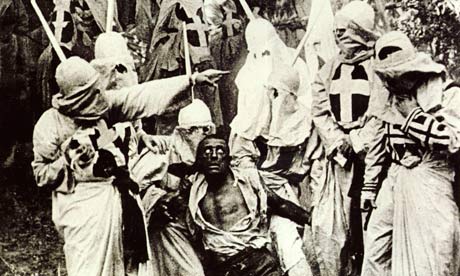
Oh, how time heals all wounds. All of a sudden by 1939 D. W. Griffith was a trendy hack and Victor Fleming (with the help of George Cukor, Sam Wood and probably a few others) was the business' greatest artist and craftsman. From the ghastly racism of Griffith's 1915 epic, The Birth of a Nation, to Fleming and company's so called work of truth and genius, Gone with the Wind, Hollywood had apparently learned its lesson. No longer would black people be portrayed as rabid dogs, foaming at the mouth over white women, or imbecile beasts. They said with GWTW, everything had changed. Black people were finally portrayed honestly. They were finally shown in their true form: the dignified, no-nonsense maid, the obedient, blubber-lipped houseman, and the chirping midwife, all happily whistling Dixie, content with the servant's life. With a bow from the movers and shakers (Selznick, MGM and the Academy) and a loud “Your welcome,” Hollywood expected a pat on the back. And in 1939 they got what wanted. But unfortunately for them, everyone has done some rethinking.
Looking back at both “Birth” and GWTW, it is clear little had changed. No wound had healed. The scar on Hollywood and all of America for that matter, was still evident. From 1915 to 1939, Hollywood had just picked away a big ugly scab and replaced it with another. In some ways, I think the depiction of black people and the Civil War era South is more troubling in GWTW than in “Birth.”
The black characters in GWTW were actually played by black people. That was a start. This cannot be said for “Birth.” And at least with Mammy (Hattie McDaniel), they were dignified. And in the case Prissy (Butterfly McQueen) and Pork (Oscar Polk), they were slightly more lovable then laughable. The black characters in “Birth” compared to those in GWTW were, as Globe critic Ty Burr might say, aggressively stupid rather than acceptably dumb. Where GWTW really allies itself with “Birth” is in its message. Both seem to want the same thing for black people: to be forever white people's help. They both strongly advocate for the traditions of the old South, just in different ways. “Birth” puts its interpretation (falsification) of the Civil War and Reconstruction and its opinion of slavery in full view, whereas GWTW dances around the issue. But considering its nostalgic glorification of Tara, and the plantations yearly ball - girls in poofy dresses frolicking around the expansive garden, with all the assistance in the world from Mammy, Pork and Prissy they could ever want - the point is made by omission.
So what's infuriating and most troubling about GWTW is that it was extremely successful. Stupidity and wrongheadedness were slipped right past us more effectively then ever. And how? By turning the schmaltz-o-meter up to eleven. We all got wrapped-up in its first class melodrama. The four million dollars (the biggest budget to date) spent on bright, gleaming Technicolor, thousands of extras playing dead, and one big smoldering set mesmerized us. GWTW features a story for the ages (adapted from the novel): a sweeping tale of lovers crossing paths at simply the wrong time. It still wows today. And who can forget such great performances. The four mil was also well spent on the perfect “damn,” dame and dude. Vivien Leigh as Scarlet O'Hara looks most bratty, neurotic, and spunky. Clark Gable appears at home playing the suave drunkard Rhett Butler. And the “damn” is a memorable cherry on top. These three d's seem to hold GWTW together and make it quite enjoyable (though I suggest spreading it out over two nights). And the ensemble directing job is not half bad at all. Characters are knocked off with the utmost precision, each death more unexpected then the last, and each more gut wrenching. When Gerald O'Hara (Thomas Michell) and Bonny Blue Butler (Cammie King) are flung off their horses, I picture them catapulted to the heavens. When Melanie (Olivia de Havilland) passes her spirit rises and sprouts beautiful white feathered wings. When Scarlet wanders off into the mist near the end, it's Melanie's spirit that guides her. GWTW, the overwrought melodrama, will endure. But like “Birth,” it will always have that irremovable blemish: its message.

Sunday, September 27, 2009

La Chinoise (1967)


By Eric Jessen 9/26/09

La Chinoise is a wonderful mockery of 60's college educated pop-tweens, featuring director Jean-Luc Godard's trademark zany bits of anti-American, anti-capitalist jest and a rapid-fire pace. But after watching about the first ten minutes, it seemed as though Godard had no intention of letting me catch up, or letting me in on the gag. Allusions to poetry, movies and history clutter the dialogue. My head nearly exploded trying to unscramble Shakespeare, Sade, and Kafka's “Metamorphosis,” Murnau, Eisenstein and Johnny Guitar, and Mao, Che and Stalin. Much of La Chinoise is a string of confusion and frustration. Godard sprints through his script (based loosely on Dostoyevsky's novel “The Possessed”) seemingly leaving ideas hanging in bunches. But what separates La Chinoise from other of Godard's political films, is that it's not mean spirited. And near the end, Godard pauses, allowing me to recollect and gather my senses. In retrospect, La Chinoise has remarkable foresight.
Godard shows a genuine love for and great understanding of 19-20ish college educated kids who fancy themselves new-wave communists, flirting with terrorism over summer break. These prim looking dolls (usually Anna Karina, in this case Anne Wiazemsky, Juliet Berto and Jean-Pierre Leaude) scamper around planning bombings and assassinations, playing revolutionaries: Juliet Berto crouches behind a wall of Mao's “little red books,” having transformed her radio into a machine gun. In the previous scene, she wears a rice-paddy hat as cardboard toy planes flutter over her head. And when these recreational Marxists talk socialism, philosophy, and the Vietnam War they clearly have absolutely no idea what they're saying. They are only pretending, criticizing LBJ as a sort of hip new jargon.
For one of the five “Marxist Leninist” revolutionaries, Veronique (Anne Wiazemsky, the girl with the donkey in Bresson's “Balthazar”), holding a cigarette gently between her fingers, dangling it in front of her mouth, slouching over, looking down, speaking softly and calmly, is her way of convincing everyone she's serious. For Leaude, as Guillaume, it's showing the unbridled enthusiasm and eagerness to scream against capitalism and recite the “little red book.” In the more quiet scenes, a subtle twitch of an eyebrow, a glance at 10 o'clock, a slight curl up of the corner of the mouth and we know for these kids it's all in fun.
When Veronique sits down with one of her professors, Francis Jeanson, a former radical himself from the Algiers days, Jeanson unravels the “Marxist Leninist's” not-so-well-thought-out plans. Veronique tells Jeanson her terrorist group intends to bomb the universities to give the bad educational system in France a chance to start fresh. Jeanson then simply asks, “What next?” and Veronique stutters. By then, I start to understand what Godard is driving at. In the late 60's, having been warped and desensitized by a bombardment of Marvel-comic-color advertising and media coverage of radical political groups, if college tweens are looking for a way to stand out and “express themselves,” what better way than to join a radical terrorist group? If they're looking for a fun activity on a mid-summer afternoon, what's more exciting an outing then a trip to city hall to assassinate a political leader. In Godard's ironically joyous point of view, thus is the psyche of the kids of “Marx and Coca-Cola.”

Sunday, September 20, 2009

The Birth of a Nation (1915)


By Eric Jessen 9/18/09

I thought I'd never watch The Birth of a Nation again. Not because I couldn't or because I didn't want to, but because I thought I wasn't supposed to. When I first watched it, I had read a lot about it beforehand so I was properly prepared. In fact my first reaction was that it didn't live up to its racist lore. My first viewing of “Birth” was just to soak in its lurid stench. I couldn't fully grasp that I had experienced what James Agee called “the beginning of melody, the first eloquence of language, the birth of an art.” So when I slouched into my uncomfortable desk with its wobbly back, forced to watch “Birth” for a second time for my “History through the Hollywood Lens” class, I felt privileged. I was glad to be given the chance to watch it again and really study it. (I wondered if anyone, other than its fans of the early 1900's, has actually seen this movie more than once. Who would dare watch it a second time? The first time you watched merely for “academic purposes.” But a second time must mean you liked it.)
I also felt giddy at the opportunity to gauge the initial reaction of a class of “Birth” virgins. I sized them up immediately: smart kids hiding a slam-bang, CGI, “Princess Bride” temperament, probably considering “Shawshank” their favorite “art film.” I stirred in my desk, eager, as the most vile scenes approached, expecting my classmates to be shocked and appalled. I expected them to cringe at the hokey racism: the ghastly make-up, white actors in blackface, foaming at the mouth with beastly lustfulness over the saintly Lillian Gish. To my surprise they acted quite mature. They swallowed “Birth's” fiery bigotry with chilling composure. I didn't hear a single gasp. Instead they turned their noses up at “Birth,” disapproving of Griffith's execution and film-making as much as his racism. They called the movie “boring,” the acting of Gish and Mae Marsh “awful,” and Griffith's direction and specifically his editing “horrible.” But when the movie ended, the class let out a loud exhale like they had just survived a gauntlet. They then applauded themselves, proud to have not fainted or fallen asleep.
I sat at my crappy desk but felt like I was perched atop a giant pedestal made of thousands of DVD rentals. I certainly considered myself the most qualified navel-gazer in the room for having previously sat through Griffith's The Birth of a Nation, his three hour extravagant mess Intolerance and his film Broken Blossoms. I watched, calm and still, searching for reasons to crown “Birth” an offensive masterpiece, while arrogantly looking down on my classmates for not being experts on the craftsmanship of Griffith. I recited in my head everything I had read about Griffith the auteur, and Birth of a Nation. In Agee on Film, James Agee called the battle charge in “Birth,” “the single most beautiful shot I have seen in any movie.” President Woodrow Wilson said Birth of a Nation is “like writing history with lightning.” Griffith's wife wrote in her book When the Movies Were Young, (written in 1925), that “Birth” shows “the stuff its citizens were made of and the reason why this nation has become such a great and wonderful country.” I also remembered what Pauline Kael wrote about Griffith's style and his two favorite actors: Gish and Marsh. In Kael's book Going Steady (one of my favorite books of criticism) reviewing Intolerance she wrote, “One can trace almost every major tradition and most of the genres, and even many of the metaphors, in movies to their sources in Griffith.” She described Gish as “a frail, floating heroine from romantic novels and poems – a maiden” and Marsh as “our dream not of heavenly beauty, but of earthly beauty.”
I felt like I was watching “Birth” the second time partially through the eyes of Agee, Kael, and Mrs. Griffith. Considering their respect for Griffith's movie making craft, I tried to watch “Birth” as attentively as possible. What I found most striking was his ability to delicately balance huge, marvelous battle scenes with small charming scenes that accentuate the elegance of Gish and the dorky enthusiasm of Marsh. Contrary to what my classmates said, I found Birth of a Nation very watchable. It moves with a sense of purpose (maybe not the most honorable one). Griffith cuts smoothly from the Cameron family in the South to the Stoneman's in the North. And his big production, his thousands of extras, and the giant battle scenes don't bog down his story. He builds suspense masterfully, especially in the scene near the end when the KKK is riding to save the innocent whites from the black Union soldiers (as ridiculous as that sounds).
I didn't find Birth of a Nation boring at all. Dare I say I found it strangely entertaining. But I can't blame my classmates for their point of view. (I reacted about the same way the first time I watched “Birth.”) And though some of the battle scenes are extraordinary and some of the close-ups of Gish and Marsh are beautiful, they are overshadowed by the film's later scenes of racism. The scenes of black legislators cooling their stinky bare feet on their desks and sloppily eating chicken wings during session are obscenely silly. Though the first half of Birth of a Nation is mostly crude-free, the second half is despicable. It's bawdy blackface for the dim-wit-KKK-redneck trade. In watching some of the later scenes, I gathered that D. W. Griffith is either virulently racist and manipulative or oblivious and hopelessly stupid.
Racist and disgusting, unbearably boring or not, Birth of a Nation is an important part of film history. To ban it completely or to chop it up into little bits like once suggested would be to deny cinema its roots. And we can't ignore the fact that D.W. Griffith the auteur and the apparent racist was a pioneer of film making and story telling. “Birth” is also a unique snapshot into the mind of the white southerner of the early 20th century. It was the biggest hit in history until Gone with the Wind, and decades later many people still believed it was the greatest film of all time.
Boring, awful, horrible, offensive, despicable, vile, disgusting, obscene, crude, ugly, lurid.... I think I could watch it again.

Wednesday, September 9, 2009

My Favorite Year (1982)


By Eric Jessen 9/7/09

My Favorite Year is a slice of showbiz nostalgia (and boy is that a cut from a tired mold) with one glaringly bad performance. Sorry Mark Linn-Baker. And unfortunately its genuine enthusiasm is weighed down by the shapeless joke-spewing style of its executive producer, Mel Brooks.
Thank goodness for Peter O'Toole. He saves My Favorite Year. This movie is proof that O'Toole is that good. Brooks, Linn-Baker and director Richard Benjamin should be kissing his feet. He gives an absolutely wonderful performance. His sarcastic grin and restless eyes tell of hidden juicy secrets. His joyful, bustling spirit make the movie worth the price of admission or a rental fee. In My Favorite Year O'Toole is perfectly cast. He plays Alan Swan, a former star of Hollywood and British Technicolor adventure movies whose career is in decline and whose off-screen shenanigans have made him a caricature on the front page of tabloid newspapers. Swan's career has sunk so low that he is forced to make guest appearances on the hammy freak-show that is mid-50's TV.
The movie is narrated by a variety hour junior writer, Benjy Stone (Linn-Baker) who tells us the story of his favorite year, the year he met his hero Alan Swan. When Swan arrives for pre-production of the show plastered and flirtatious, wearing his tear-away “drunk suit,” Benjy has to convince the star of the show “King” Kaiser (Joseph Bologna) not to dump Swan. As a compromise Benjy is assigned to babysit Swan. For the rest of the movie we follow Benjy following Swan. He makes almost no attempt whatsoever to keep Swan under control other than acting hysterical. But all the more fun for us. Swan parades around with a reckless abandonment. O'Toole couldn't have played it any better. It's clear from the start that the Swan character is based on the infamous romantic charlatan Errol Flynn. For those of you familiar with 50's TV shows, the variety hour is based on the Sid Caesar program in which Flynn made a guest appearance. And the Benjy Stone character is likely based on one of the young Jewish writers for Sid Caesar, Woody Allen or Mel Brooks.
(Side note: My Favorite Year reminded me of Truman Capote's charming piece “A Beautiful Child.” Capote, a self-proclaimed master of memorizing dialogue, gives a detailed description of a few hours he spent with Marilyn Monroe including every remark and every anecdote filled with her famous swearing. What came to mind while watching My Favorite Year in particular was a story Marilyn told Capote about Errol Flynn. “Marilyn: Did I ever tell you about the time I saw Errol Flynn whip out his prick and play the piano with it? Oh well, it was a hundred years ago, I'd just got into modeling, and I went to this half-ass party, and Errol Flynn, so pleased with himself, he was there and he took out his prick and played the piano with it. Thumped the keys. He played You Are My Sunshine.”)
It's this flamboyant Flynn along with a lively performance by Peter O'Toole that is the heart and the charm of My Favorite Year. Alan Swan swung from banisters (as Flynn did in The Adventures of Robin Hood) and smooched gorgeous women in his movies. Everyone loved him and let him do whatever he wanted. But the hero-worship got in his head. He began to see the man in the mirror and the characters projected on the big screen as one and the same. As result he is constantly acting. We watch him play the part of the hero and as his career declines the part of the washed-up actor. We watch him play the part of the hopeless drunkard pulling bottles of scotch out of his trench coat, and the unconscionable womanizer stealing tarts from snobs at fancy restaurants. We watch My Favorite Year and afterwards we forget about its downsides and remember Peter O'Toole as Alan Swan and we remember Errol Flynn: the exuberant swashbuckler and adorable lush.

Friday, September 4, 2009

Pale Rider (1985)


By Eric Jessen 9/3/09

In Pale Rider, Clint Eastwood (the director and actor) conjures-up the ghost of dead westerns. He regurgitates hero-worship, Sergio Leone “Man with No Name” mythology: the Shane story with the High Noon walk-of-doom. Eastwood also tries to add an esoteric panache and a religious vein. The scenes with a spiritual air glide with a sense of purpose. But too often they come to a thud, fumbling over clunky cliché chunks: tedious man-on-horse stuff that is better left in past movies.
As always Eastwood (the actor) plays the larger-than-life figure: the no name drifter. He does his same old act although once again rather convincingly: flashing his unmistakable menacing glare, towering over tiny villagers with his statuesque build, staring at a nemesis in a showdown, riding on his white horse with a stone-faced self-assurance.
In Pale Rider Eastwood (the director) adds a little extra artsy flair which caught my eye. His character seems to sift through the cold breeze of Gold Rush era California like a transient spirit: a blur in the distance, appearing in the corner of your eye then suddenly vanishing. This kind of myth-mongering may sound familiar but Eastwood gives it a real religious tone. Obviously feeling quite confident in his on-screen dominant presence, Eastwood gives himself the role of a supernatural mishmash of Jesus, The Grim Reaper and a vengeful reincarnation. His face tightens more then ever. And he becomes all the more predictably unstoppable (even standing up to Richard “Jaws” Kiel). He adds layers to his usual impenetrable shell. But Eastwood really couldn't play it any other way. And part of me loves the stability he brings. I can always count on Eastwood to bludgeon the bad guys while staying untouched and cool. In every scene Eastwood reeks havoc but (maybe to the fault of the movie) everything stays calm and under control.
After a remote, small village of huts and log cabins is devastated by the annoyingly idiotic, barbaric goons (they even gun-down a puppy) who work for a greedy mining boss, Josh LaHood (Chris Penn), Eastwood arrives as “the miracle” in response to the hopeful prayer of a young girl, Megan (Sydney Penny). He finds the girl's father-figure, Hull Barret (Michael Moriarty), being beaten by some of the of buck-tooth delinquents. Eastwood immediately makes his presence felt: promptly bashing-in four heads with a stick. Eastwood then slaps on a white collar, joins Hull back at the battered village and becomes the “Preacher.” He brings the few remaining villagers together and gives them courage to fight against the evil LaHood. (By the way, Eastwood couldn't resist giving his spirit character a woman to sleep with.)
When LaHood offers each villager $1,000 to leave, with the guidance of Hull and the Preacher, the villagers decline. As a result they face the wrath of LaHood's seven killers: the ruthless Marshal Stockburn (John Russel) and his six deputies. Just as the final confrontation is about to occur, Eastwood takes off his white collar and straps on his holster. Apparently he's got “some unfinished business” to settle with Marshal Stockburn. Eastwood rides to town and takes the lone walk (as Gary Cooper did) up a deserted street to meet Stockburn and his six deputies. The seven killers step out of LaHood's office and neatly align for a spaghetti-western-esque face-off. Of course, Eastwood drops all six deputies with ease. He disappears from the middle of the street then kills each deputy one-by-one, popping up from a water main (which looked hokey), then out from behind barrels. Eastwood walks up to the marshal. Shockburn shouts “You!” And Eastwood, now channeling Death, shoots Stockburn five times in the same spots Eastwood has mysterious bullet wounds. He then hops on his horse and rides away. Adhering to the Shane formula, the young girl Megan runs after Eastwood, stops at the edge of town and shouts “Preacher! Preacher!...We love you Preacher...I love you!...Goodbye!”
In Pale Rider, Eastwood gives old movie myths new life but unfortunately some of the myths seem as cliché as they always did.