Thursday, September 3, 2009

This Man Must Die (1969)


By Eric Jessen 9/2/09

Claude Chabrol's This Man Must Die has a mannered propriety. The actors' stiff-neck posture and drab, quiet tone are worthy of a Robert Bresson film. These kinds of films by directors like Chabrol, Bresson and others, which are usually foreign and usually French, are like a fine wine for the movie critics who snicker at the bulbous Hollywood studio productions. But for the average audience this style is an unbearable bore. And although with many of the movies with this style I'd say, “let 'em squirm.” (I absolutely love Bresson's Mouchette and Chabrol's Le Boucher and I don't care that the modern, average audience would think they were boring.) But with This Man Must Die Chabrol has practically committed highway robbery. He uses his style to bog-down an otherwise routine, guaranteed-to-be-entertaining manhunt story. He rips the fun out of shamelessly fun story.
The film begins with an elegantly photographed drive-by killing of an innocent small child. We see a man driving away in his dented car blurt with a vulgar attitude, “Shut up” to a beautiful woman crying next to him. We then see the title, “This Man Must Die,” and the opening credit: “Adapted from the novel 'The Beast Must Die.'” These titles are very self explanatory. We soon meet Charles Thenier (Michael Duchaussoy), the father of the dead child. It's very obvious what Thenier is going to try to do. Despite the fact that tracking down a man he knows nothing about seems impossible, and even after the police do an extensive search and come up with no leads, we know somehow, (through some unbelievable coincidences), Thenier will find his man. And somehow this man will die. But the ride in tracking down the wretched man who would run over a small girl and leave her for dead is a drag. And the eventual death of the drive-by killer is very unsatisfying. (By the way, the drive-by killer is played very well by Jean Yanne.) The movie gets caught in its own ambiguous twist and never fulfills us with a grab-him-at-the-color, let-him-have-it death. We know the drive-by killer dies but we never actually see it. It's a crucial let-down.
With Chabrol's This Man Must Die, the combination of the quiet French style with what is already a conventional, relatively predictable story was destined to be dull. I can only guess that the posturing of a simple manhunt thriller was intended to be ironic and funny. Maybe it was supposed to be a tame version of a Luis Buneul black comedy. But that doesn't show. Instead the movie feels like an awkward mismatch. The suspense of the tracking down and killing of a horrible man falls flat in the uncomfortable pauses, the swallowing of outbursts and the repressed emotions.

Wednesday, September 2, 2009

Rumble Fish (1983)


By Eric Jessen 9/1/09

Rumble Fish looks like an artsy masterpiece: a tactile, grimy and grungy black-and-white wonder. But the visual assault, the relentless style suffocates the characters and the performances. It blurs any glimmer of a story. And an awesome cast which includes some of my favorite actors (Mickey Rourke, Nicolas Cage, Dennis Hopper) is wasted. They take a back seat to Francis Ford Coppola and the cinematographer Stephen H. Burum's extreme camera angles and Wellesian deep focus.
Rumble Fish is dazzling and it looks original. It has the visual indulgence that reflects the work of a "real artist.” It has the carnival extravagance of a late 60's and 70's Fellini and the photography of street corners and shadowy alleys remind me of 20's and 30's German expressionism. Unfortunately Rumble Fish is a movie without a base. The structure, the story and the characters are flimsy. They seem adrift in the endless fog of an unnamed urban city nightmare. We hold on by a string.
The only coherent character in Rumble Fish is Rusty James, a local biker gang hero played with a naive teenage-jock obliviousness by Matt Dillon. Rusty has taken over as the leader of the biker gang while his brother, a local legend known as “The Motorcycle Boy” (Mickey Rourke), is in California. Rusty rounds-up his brethren, Smokey (Nicolas Cage), B.J. (Chris Penn), Midget (Laurence Fishburne) and Steve (Vincent Spano). They skip down to an abandoned garage or prance around under a bridge for fights against rival gangs like the “Jets” or “Sharks” from West Side Story. After Rusty is cut across the chest by his nemesis Biff Wilcox (Glenn Withrow), the Motorcycle Boy unexpectedly appears and comes to Rusty's rescue. Mickey Rourke does his best to play the slightly crazed biker gang legend. He thickens his throaty whispers, his hair is crumpled and disheveled. Rourke looks dazed and confused in the role. He's stripped of the “suave desperation” that he had in Diner and the calm and sturdy demeanor he had in Body Heat. The jarring low angles and uncomfortable close ups mixed with misty, murky medium shots make Rourke's character seem like a ghost. That was probably the intention, but with Rourke I'm used to having something “real” to grab on to.
Rusty and the Motorcycle Boy's poor, boozing father is played by Dennis Hopper. Considering his part in Apocalypse Now and especially his later performance in Blue Velvet, Hopper seems perfect to play a dirty old, inebriated bum. He's a very entertaining over-actor and his over-the-top showiness usually pops. But in Rumble Fish Hopper simply blends in to the dream world with the cast of quasi-realistic characters.
As Pauline Kael once said about art-conscious movies, they float but never touch the ground. This is definitely true of Rumble Fish. But taking into account Francis Ford Coppola's rough stretch in the 80's, the bankruptcy of his company, the failure of One From the Heart, I'm glad to see that he's once again made something that at least floats in the first place.

Tuesday, September 1, 2009

Good Will Hunting (1997)


By Eric Jessen 9/1/09

Matt Damon and Ben Affleck deserve a pat on the back for their warm hearted script. Damon, Affleck, Robin Williams, Stellan Skarsgard and the entire cast give a great effort on this nice-try, well intentioned project. But in Gus Van Sant's bleached, TV-lighting and with all around bad timing, the performances, Affleck and Damon's “Southie” talk and the overwrought therapy-blubbering seem forced. And Good Will Hunting plays like nothing more than soft melodrama with good cliché sense.
From the start it's hard to tell the aim of Good Will Hunting. We follow Will Hunting (Matt Damon), a closet genius wearing a janitor's outfit. He has a photographic memory. He knows everything about everything: history, physics, chemistry, art and especially math. Will can scribble down the answer to a problem that has puzzled mathematicians for years on a napkin over lunch. But he chooses to conceal his intelligence. (Although we're allowed an obligatory scene where “wicked smaaht” Will shows-up a Harvard "prick".) He prefers the romanticism of good honest construction work, drinking beer and smoking at the local pup with his buddies over the snobbishness of a well-paid job and a Nobel Prize.
Good Will Hunting seemed to be shaping into a study of unrealized potential. Will's best friend Chuckie (Ben Affleck) tells him, “I'd do anything to have what you got....You're sitting on a winning lottery ticket and you're too much of a pussy to cash it in.” But midway through it starts to look more like a Freudian mess. We delve into Will's psyche, his childhood of abuse, his orphanage, his fear of commitment and vulnerability and abandonment etc. He sits across from his therapist Sean (Robin Williams), at first he doesn't speak, he twiddles his thumbs and watches the clock as the hour required by his P. O. ticks away. But then, Will and Sean become best friends, they share stories about famous Red Sox games. And eventually they share tears: Sean over his wife who died of cancer and Will over his past.
Good Will Hunting comes to a predictable end but we remember the little cliché moments and the various actors' energy: in particular Chuckie's four-letter “Southie” jive spoken with a comfort level and an understanding of the immature, adolescent bravado by Ben Affleck. And you'll never forget the famous but unbearably corny scene where Sean tells Will over and over, “It's not your fault. It's not your fault. It's not your fault.” He says that three more times before Will starts weeping uncontrollably.
By the end Good Will Hunting had shaped into a sloppy melodrama. Ben and Matt and Gus Van Sant cashed in a big box-office success. Good for them. And thankfully, Good Will Hunting at least catapulted Matt and Gus Van Sant into making much better movies.

Sunday, August 30, 2009

Forty Guns (1957)


By Eric Jessen 8/29/09

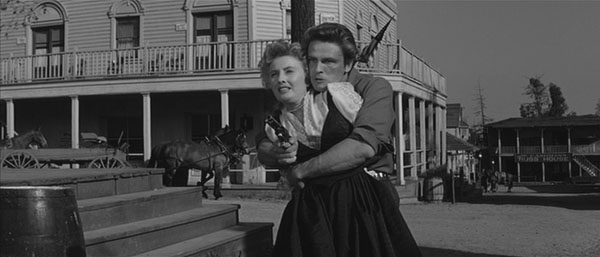
Samuel Fuller's Forty Guns is covered with annoying clumps of throw-away conventional cinema. But underneath it is a wonderful mock-western. The Arizona 19th century frontier is stripped of its man-on-horse love affairs and macho honor code (Peckinpah-esque) babble. The dusty, hairy and dirty wild west is replaced by a drab, clean-cut town. The cowboys look more like city slickers, as fit to hold a tommy-gun as their Colt-45. The violence isn't overly drawn-out with shifty eyed stare-downs and High-Noon-esque staginess. Instead, it is spontaneous, sometimes anti-climatic and the results (who lives and who dies) of the shootouts and bar-room brawls are unpredictable.
Forty Guns is about U.S. Marshal Griff Bonnell (Barry Sullivan) who is sent to an Arizona town to arrest Howard Swain (Chuck Roberson). When he finds Swain, he learns that Swain is one of the 40 hired guns of local landowner Jessica Drummond (Barbara Stanwyck). Drummond and Bonnel eventually cross paths which leads to a romantic relationship.
Taking the aforementioned clumps into consideration, Forty Guns has its peeks and valleys. There are moments of dull conversation, there are some lame set-ups. But there are also moments of crazy, unkempt activity (real movie-fun), the kind of moments you'll always remember (your brain attaches a mental post-it note). They're great attention grabbers. Samuel Fuller is giving a joyful wink to the audience when he shocks or appalls, when he breaks unwritten rules.
In Forty Guns when Griff Bonnell is confronted by a drunk hooligan, Brockie (John Ericson) who has just terrorized and shot-up the town, don't expect them to take 10 steps in opposite directions, turn and fire. Instead Griff simply walks comfortably towards Brockie, as Brockie screams and threatens to shoot, and then abruptly pulls his gun out of his holster and thumps Brockie over the head. In a Samuel Fuller quiet Arizona town, don't expect a peaceful wedding: as the picturesque newlyweds share a first kiss, the husband is shot down. In Forty Guns don't expect a heart-to-heart conversation to reach its tear-jerking climax, that too is liable to be cut short by gun fire. I cherish all of these great little moments of artless violence. They can be silly or ridiculous but they're always entertaining. And my favorite moment in Forty Guns is the ending (ignoring the final two scenes added on top because the producers disapproved). It's a fantastic slap in the face to westerns. Griff's girl, Jessica, is being held up by one of her 40 guns, Brockie (the same hooligan from earlier). Brockie yells at Griff, “I'd like to see you shoot her!” Then, wasting no time, BANG! Jessica is down, then BANG... BANG... BANG......... BANG! Brockie is dead. Griff walks past them with a cold forcefulness, never once looking down at the two bodies.
That scene brings to mind one other interesting thing about Forty Guns: its phallic love for guns. All the characters in the movie talk about guns with a strange passionate attentiveness. Jessica says to Griff, “I'm not interested in you, Mr. Bonnell. It's your trademark,” pointing to his gun, purring. She then says, “May I feel it?” The trigger clicks... BANG....and they get goosebumps all over. One shot after another from their freshly polished pistol is how they get off. They treat each other like strangers and their guns like a loved one, their one and only companion. At the end when Griff shoots Jessica, he has expressed his deepest feelings for her. Griff shooting Jessica at waist level is their way of consummating.
With Forty Guns, despite its final two scenes, despite some boring characters and listless performances, I can think fondly back on the spontaneous violence and the hilarious covertly sexual dialogue. I love Samuel Fuller the fringe, pulp-movie director. And what I love most is his willingness to shock me.

Saturday, August 29, 2009

The Big Lebowski (1998)


By Eric Jessen 8/28/09

The Big Lebowski is a hilariously entertaining film. F-bombs and pot-belly, shaggy-dog laziness only add to its charm. Joel and Ethan Cohen approach a film about a group of slouches and bums with a joyous twinkle in their eye. They pepper the dialogue with everyman cursing. They run the movie to a first class mixed tape. And they also show off a taste for LA flashy style. It's enthusiastic and playful. We welcome The Big Lebowski as a sort of camp fire tale, told by baritone old west Sam Elliot, about a man we all know: “The Dude.” He straddles a dangerous line of unemployed, on and off the streets and indifferent. But “The Dude” never gets too down, he somehow stays afloat. And though we may berate him for not being motivated (which makes us feel superior), part of us wish we were a dude. We wish we had carefree nonchalant swagger and stress-free life of nothing but bowling and avoiding paying rent. And The Big Lebowski is “The Dude's” wild ride. Our dude, Jeffrey Lebowski (Jeff Bridges), sets down the beer in one hand and pulls his fingers out of the bowling ball in the other hand. He tilts down the shades covering his eyes, flicks back his overgrown bangs, scratches his scruffy beard and side burns. He picks himself up off his minor weed high and is ready to roll.
In The Big Lebowski our dude finds himself in a sticky situation. One night after shopping for some milk at Ralph's, “The Dude” comes home and is beat up by two thugs who mistake him for another Lebowski (David Huddleston) who owes them money. During the break-in one of the two thugs urinates on his favorite carpet (which he says “really tied the room together”). So our dude decides to for once go against his pacifist instincts and confront the other Lebowski who is apparently rich and ask him to replace his carpet. “The Dude” saunters into the other Lebowski's mansion but his pleas for a new carpet are to no avail. So, of course, what does “The Dude” do? Well, he steals a carpet, that's what. Now he has a beautiful Persian rug as the centerpiece of his room. Not long after, the other Lebowski calls “The Dude” back to his home with an urgent request. He tells “The Dude” that his trophy wife Bunny a ditsy teen played by Tara Reid, has been kidnapped. And if “The Dude” will be the courier for a 1 million dollar payoff, he'll get paid $20,000. When “The Dude” tells this to his bowling buddy Walter (John Goodman), a high-strung Vietnam Vet who pulls his gun on people who violate bowling rules, Walter takes control and concocts a ridiculous plan for the drop off. He packs an Uzi into a paper bag and his dirty undies into a suitcase that will serve as a decoy for the kidnappers, so Walter and Lebowski can grab Bunny and keep the money.
Over the course of his wild ride, “The Dude” finds himself at a gated community police station, watching Walter demolishing a convertible to intimidate a teenager, in a bowling-ball-vs-sword fight with a German leather-pants band, and inadvertently drinking an acid, roofie spiked “White Russian” at a porn Tzar's house. He is thrown around like a ping-pong ball to every corner of LA, to every weird person in town. And it is fun to watch him sigh, irritated that all these shenanigans interrupt his lounging routine. He sits at the bar and orders his favorite drink. He laments to the bartender about a rough day. But he still keeps a small smirk on his face. He gets up, whips back his hair, and slowly and smoothly puts on his shades remembering, I shouldn't be whining, I'm a dude.

Friday, August 28, 2009

Synecdoche, New York (2008)


By Eric Jessen 8/27/09

From Adaptation, a movie about Charlie Kaufman (played by Nicolas Cage) writing the script for Adaptation, to Synecdoche, New York, a movie directed by Kaufman about directing, Kaufman attempted to take a step toward the truth in his creative madness. But unfortunately I think he only found a bigger disaster and more confusion. And the once lovably jittery and quirky writer has shifted and evolved into a foreboding director.
In Synecdoche, New York Kaufman's on-screen persona is Caden Cotard (played by Philip Seymour Hoffman), a theater director whose life is unraveling. For Caden it's one ailment after another, one visit to the hospital after another. He is always deteriorating. His marriage is crumbling. Finally his wife (Catherine Keener), who is an artist of miniature paintings, leaves him and takes his daughter. Caden then starts flirting with Hazel (Samantha Morton), a delicate box-office girl. But after Caden crumbles under carnal pressure one night in Hazel's bedroom, he's left feeling inept and humiliated.
At this point “Synecdoche” is simply keen melodrama: well acted and engaging if maybe a little depressing. But then unexpectedly, Caden receives a MacArthur genius grant which gives him unlimited funding to pursue any artistic whim. This also gives Kaufman unlimited freedom in depicting the “creative process,” (obviously his favorite topic). In Adaptation he was forced to do this with narration because his on-screen persona was a writer. With “Synecdoche,” because his persona is a theater director, his thoughts and ideas can come alive on stage.
Caden decides to make his masterpiece, a huge all encompassing work of art, a brutally honest and realistic depiction of his plight and what he believes is his rapidly approaching death. Caden assembles a large cast, he chooses a gigantic warehouse in the NY theater district to house the project. At first his somber, depressing piece seems focused: It's about “Death!” But as his life becomes more confusing, so does his play. He concludes, “I don't know what I'm doing.”
In the deep and scary abyss that is “writer's block” also known as the “creative process,” Caden does as Kaufman did in Adaptation, except he takes it even further which ends up being a step in the wrong direction. In Adaptation Kaufman dug himself out of a “writer's block” hole and a muddle of conflicting ideas by deciding to write the script about the writing of the script: including all the funny stories, reflecting on his social awkwardness, then finally relating it to it's original aim (Kaufman was supposed to be adapting The Orchid Thief). But with Caden's piece, instead of being retrospective, he only deepens the “writer's block” hole. Instead of making a play about how he was struggling with the “creative process” and a terrible, nerve-racking life, he makes an endless play about how he is continually struggling with the “creative process” and his nerve-racking life. As a result the giant warehouse becomes a stagy replica of Schenectady and NYC. His actors mimic everything happening in his life. He hires a woman to play Hazel and another to play his wife. His actors play their parts non-stop. He creates a copycat world to study, maybe so he can discover what is causing his pain.
Synecdoche, New York is at times a synecdochical, poetic delight: thoughtful and fascinating. But in the end it is a mad spiraling-out-of-control mess. The mass of ideas converge and form a confounding, bewildering blob. I was also exhausted and tired from watching Caden's relentless trepidation and bemoaning. But then again as frustrating as the movie is, it comes to a perfect end, its only logical conclusion. The endless spiral, the blob of ideas surrounding Caden finally vanish. He has a serene “writer's block,” “creative process” death. I guess, it's what he had anticipated all along. He falls into the arms of the actor playing him and says just before he passes, “I know how to do this play now. I have an idea, I think...”

Thursday, August 27, 2009

Inglourious Basterds (2009)


By Eric Jessen 8/26/09

Quentin Tarantino is a unique director. He is the ultimate movie geek film maker. His movies are an endless homage, a slapped-together mash-up of exploitation b-movies and his Fave 5 soundtracks (Ennio Morricone spaghetti-western music and David Bowie's “Putting Out Fire” from the 1982 remake of Cat People). They are whimsically gory and sarcastically serious. They indulge QT's extraordinary movie love. He is lovably hip if somewhat childish, wearing tennis shoes and giving the peace sign on talk shows. And with Inglourious Basterds (speaking of childish, what a title) QT has nearly accomplished something unprecedented. At least for a good portion of the movie Inglourious Basterds is the first funny, entertaining cartoonish slam-bang action spoof of the Nazis and the Holocaust.
The movie is made up of 5 chapters. The first begins at a quiet dairy farm in 1941 occupied France where SS officer Hans Landa, aka “The Jew Hunter” (played by Christoph Waltz who won the best actor award at the Cannes film festival for his performance), is visiting the LaPadite family out of suspicion that they are hiding Jews. In another chapter we meet the “Basterds,” a renegade group of Jewish American soldiers tracking down and killing as many Nazis as possible. Their leader is Aldo Raine (Brad Pitt), aka “Aldo the Apache,” a rough and tumble hick from Tennessee. Other note worthy “Basterds” are “The Bear Jew” (Eli Roth) who clubs German skulls like Ted Williams does baseballs and Hugo Stiglitz (Til Schweiger) known as a master of slitting throats.
For the most part Inglourious Basterds is a success and the ending a wonderful rewrite of history, the perfect “burn baby burn” Nazi slaying. But unfortunately the movie stumbles over a few attempts at seriousness. As a result the collection of scenes seems uneven. The bursts of raucous comic violence clash with drawn-out scenes of genuine tension. Most of the 5 chapters begin slowly with scenes of interesting subtle dialogue and then end with guns blazing.
Even some of the individual scenes seem off balance. I think this is mainly because of the brilliant performance of Christoph Waltz as the chilling and menacing SS “Jew Hunter.” Waltz brings a seriousness and believability to his roll which is sometimes awkward to watch because he is paired with characters that aren't at all serious (especially Brad Pitt and his silly accent). His performance adds a new more complex dimension to the film, but one I think Tarantino isn't ready to handle.
Watching Inglourious Basterds, we laugh and get excited at the scalpings, Aldo poking and digging his finger in a bullet hole, carving swastika's in German soldier's foreheads. We get all riled up for a Tarantino stylish sadistic blood bath (in a sexy Nazi red) because his lack of seriousness allows us to ignore any of the horrible, sad implications of death. But the second I closely connect to a character or in this case see the true Nazi in Hans Landa, the endless corpses take on meaning (Landa's strangling of Bridget Von Hammersmarck played by Diane Kruger is the first brutal hard-to-watch death I've seen in a Tarantino movie). The nasty implications of Inglourious Basterds rear their ugly head. I remember I'm not supposed to laugh and have fun watching a movie about WWII and the Holocaust. And the somber topic is a total buzz kill of my Tarantino Nazisploitation thrill ride.