Wednesday, August 26, 2009

Point Blank (1967)


By Eric Jessen 8/24/09

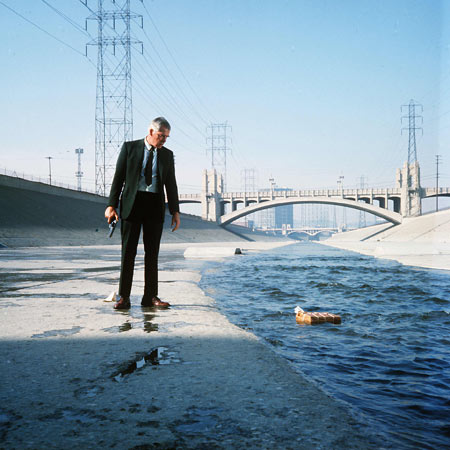
Point Blank is a routine revenge film made dazzling and mesmerizing by hip sixties style and French New Wave cutting. We find Lee Marvin, his face pockmarked and battered as usual, dazed and confused, lying in a puddle of dirt on the floor of an Alcatraz prison cell with two bullet holes in his chest. The film is cut and slashed, we jump back to a heist gone wrong. Marvin as “Walker” and his friend Reese (John Verner) steal thousands in cash from a helicopter transporting Mob money to the prison, known as the “Alcatraz drop.” But Reese then betrays “Walker” taking his $93,000 share, making off with his wife (Sharon Acker) and leaving Walker for dead at the prison. The background turns to an Andy Warhol-esque swirl of oranges and reds, a color splurge (like a psychedelic finger painting). The opening credits roll. Then for the rest of the movie we follow “Walker” living out his vengeful fantasy, cutting back and forth, flashing back to the cell, back to the heist, back and back again, over and over. Walker hits San Francisco landmarks, patrols under the highway bridges of Los Angeles, and then at the end drifts into a dark shadowy oblivion back at Alcatraz.
Was it all Walker's last dream? Did Walker die at Alcatraz or did he recover? (At one point Angie Dickinson tells Marvin, “You died at Alcatraz.” ) One of the treasures of Point Blank is that these questions are left unanswered. Walker remains an enigma. He sifts through LA and San Francisco like a ghost. Lee Marvin's stiff cold demeanor and statuesque figure, his leathery skin blend in with the silver coated cities, the straight-cut fashion, satin faded pastel colors, (Dickinson's yellow striped dress) prim models, mini-skirts and leopard-skin sheets.
Walker tracks down Reese, his wife, and the mob men responsible for the “Alcatraz drop,” leaving mounds of corpses behind. But strangely enough, Walker never actually kills anyone. Sure, he roughs up a few body guards but only ever in self defense. He instead acts as a kind of evil spirit causing Reese, his wife, and the mob men to either kill each other or themselves.
Point Blank is an exhilarating if sometimes confusing ride of brute bullish action glossed with smooth, sleek style. But it is also a stifling of emotions (except for the brilliant scene where Dickinson slaps Marvin repeatedly to no avail). In this world of jazzy music and stoned faces, violence is inconsequential and sex is trendy.
A dream or not, Point Blank with Marvin's degenerate steamrolling, Dickinson's sexy fleshiness, John Boorman's New Wave showoffish directing, the pulp novel “The Hunter” turned pulp-action 60's vogue movie is a thrill.

Sunday, August 23, 2009

Sophie's Choice (1982)


By Eric Jessen 8/22/09

Sophie's Choice is a heart-melting, tear-jerking guilt trip. Layers of intrigue unfold with an exploitive, manipulative touch blurring our memory of gratuitous posturing.
The first layer has a campy artificial glow. We meet Stingo (Peter MacNicol), a sweet southern writer who has moved to a cute old boardinghouse in Brooklyn, and an odd couple, Sophie (Meryl Streep), a Polish immigrant and her lover Nathan (Kevin Kline). They are a match made in cliché threesome heaven. Sophie is beautiful but vulnerable and naïve. Nathan is erratic and abusive but exciting. And Stingo is the perfect third wheel, soft-spoken and thin-skinned, standing idly by watching Sophie and Nathan's destructive relationship, worshiping Sophie while subtly loathing Nathan. Scene after dull, predictable scene our threesome play the same game. Sophie and Stingo begin a conversation. They seem to be connecting. Then suddenly in pops Nathan with his strange but fun-at-heart antics, stealing Sophie's attention. The camera focuses on Stingo as Nathan and Sophie kiss and cuddle. We see him look down at his feet, pouting like a sad puppy. Awkwardness sets in.
These opening scenes are kind of boring and much too clean but I think maybe intentionally so. After 30 minutes we are lulled to a near sleep, already tired of the characters. I was thinking, did Streep really win best actress for this? But little did we know that in Sophie's Choice when you chip away the layer of campy fun (?) underneath you'll find a thicker layer of gut-wrenching melodrama and guilt mongering exploitation.
To our surprise both Nathan and Sophie have “ugly” secrets. We learn Nathan's occasional rant or tirade and dressing-up-in-costumes exuberance can be explained by his paranoid schizophrenia and cocaine addiction. (Only in the movies does a short temper, jealousy and enthusiasm indicate mental disorder and a drug habit). This strange revelation coming near the end was an unnecessary jolt. The cocaine piece was too much. I think mental disease would have been more than enough. And Nathan was already forgotten by this point. Our attention was totally wrapped in Sophie.
Early in the movie we saw that Sophie had a number tattoo indicating she was a prisoner of the Holocaust. And in one of the heart-to-heart talks with Stingo she alluded to problems she had with her father in Poland. (I put the Holocaust stuff in my memory banks expecting it to come up later.) Then midway through the movie Sophie once again sat down with Stingo, the camera closed in on Meryl Streep's face (this is when she won her Oscar) leaving us no wiggle room, no way to ignore Sophie's story. She then unveiled her depressing past, her memories of Auschwitz and her fateful “choice.” We see in flashbacks that Sophie was once married with children in Poland and her father was a Nazi supporter. She and her children were taken to Auschwitz for being Polish. There she was forced by a Nazi guard to choose between her two children, who lives and who dies.
My heart was pounding. My first thought was that Sophie's Choice is a great movie and that Streep's performance is unbelievable (she deserved the Oscar). But I remembered a low, awful feeling while watching. I remembered my boredom from watching the early scenes. And I remembered a specific manipulative lurid cut in the flashbacks. (We see Sophie and her two children on a train heading to Auschwitz. The camera zooms in on the two kids. They are trembling, clinging to their mother. Then cut to smoke shooting out of gas chambers.) I realized that the light-hearted early scenes are a device to lure us in or at least warm us up. Feeling we're on even ground, we welcome Sophie, Stingo and Nathan's problems and stories, unaware we've been made an easy knockout for stomach churning guilt and teary-eyed melodrama.

Friday, August 21, 2009

Full Metal Jacket (1987)


By Eric Jessen 8/21/09

Don't be fooled by sharp tongue, sardonic soldier-jive (plucked from Gustav Hasford's novel, The Short-Timers) or the early scenes of Marine Corp S&M. Full Metal Jacket is undoubtedly Stanley Kubrick's least imaginative film and his most disappointing.
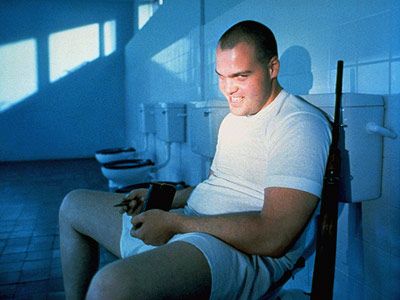
The film opens at recruit training camp where heads are shaved to the music of “Hello Vietnam.” In the midst of crotch-grabbing silly chants (“This is my rifle, this is my gun. This is for fighting this is for fun”) the first part of “FMJ” has a macho self-punishment nightmarish vivacity. The skin head “maggots” are spit on and berated by drill Sergeant Hartman, played with a cartoonish over animated temper by Lee Ermey. He shouts obscenities and idealizes the marksmanship of Lee Harvey Oswald while praising the Virgin Mary. Hartman in particular verbally abuses and humiliates the incompetent, overweight Leonard who he names “Gomer Pyle,” played by Vincent D'Onofrio. Hartman's tough love slowly turns Gomer into a gun-groping psychopath which finally leads to a confrontation. D'Onofrio tilts back his eyes, half smirks and drools to best mimic the warped, crazed look.
We jump from the neatly folded white sheets, bunk beds and synchronized jogging of the camp base to an only slightly more chaotic, not at all intimidating Vietnam (Kubrick chose to film in England), which pales in comparison to the frightening jungle in Platoon or Apocalypse Now. Oliver Stone's Vietnam makes Kubrick's look welcoming. We follow “Joker,” (not that he's funny), a correspondent for the “Stars and Stripes” military propaganda paper, played by Matthew Modine. Modine has the sarcastic grin of Malcolm McDowell in A Clockwork Orange, but none of the devious bite or intelligence. The “Joker” is totally uninteresting. But I'm not sure I should blame Modine. Kubrick gives him nothing to do and no time to shine. Actually, all of the characters in the film are no more human or engaging than “HAL” from “2001.”
In the second half of “FMJ” we don't closely follow any characters and there isn't much of a story. It is more a collection of dull vignettes. Kubrick uses steady-cam to death giving us the illusion of a story moving forward. (I'm having trouble remembering what actually happens.) Oh, “Joker” and his photographer Rafterman (Kevyn Howard) fight off the North Vietnamese Army during the Tet Offensive. They go to Phu Bai and fight, usually in the traditional way: moving slowly forward, hiding behind rocks or walls.
When journalists interview the soldiers and ask what they think about the war, they all give strange, stoned faced answers: some talking about trivial things, others sounding racist. I think Kubrick is trying to convey that the soldiers have become indifferent about killing and desensitized. But the setting is non-threatening. We never felt a connection to the characters (maybe the split second before their hair was shaved in the first scene). As a result the message seems arbitrarily supplanted to make the film anti-war trendy.
I think I would let all of this go if in the second half the film retained its sadistic comedy. But that is also left at training camp with Gomer and the drill Sergeant. There are bits of irony like “Joker's” helmet which has a peace symbol pin attached and “Born to Kill” written on the side. But the humor lacks a character center. It's like a Kubrick movie without an actor to give one menacing stare (which Gomer does in the bathroom scene).
The first part of the movie has a dark irony horror show vigor, the unique audacity of Kubrick giving us a jolt and even living up to hype. But the rest falls flat on its face. It is slogging in war movie clichés and by the end I'd nearly forgotten Gomer and the famous soap socking scene.“FMJ” features some of Kubrick at his worst: suffocating actors until he doesn't have any characters. It also in the end fails to live up to our enormous expectations for a Kubrick movie. And although Kubrick is great at damage control - rousing us with a catchy soundtrack, a few beautiful shots, and fun foul mouthed dialogue - Full Metal Jacket is for Kubrick, shockingly banal.

Thursday, August 20, 2009

The Lady from Shanghai (1948)


By Eric Jessen 8/19/09

An Orson Welles film destined for failure, a box-office flop, cut to pieces (maybe rightfully so) and turned into a confounding mess, is no doubt destined for legend.
As the story goes, Orson Welles was once again in way over his head on a project. He was attempting to remake Around the World in Eighty Days adding an ironic twist. Of course he needed money, 50,000 dollars, so he made a deal with Columbia producer Harry Cohn: Cohn would lend him the money if Welles would write, direct and act in a film with Columbia star Rita Hayworth (Welles' wife at the time) for no further fee. When Cohn asked Welles what the film would be about, Welles, standing in a hotel lobby, glanced at the book stand and suggested the film be based on If I Die Before I Wake. Which he had never read.
The film was slapped together in less than a year but as with all Welles films, much time was needed for heavy editing. The result is The Lady from Shanghai: chaotic, perplexing, labyrinthine (Cohn famously offered 1000 dollars to anyone who could explain the plot), featuring bits of brilliance, bad dubbing, overlapping dialogue, strange camera angles, awkward gaps that are an indication of cut footage (all Orson Welles trademarks). It's the Welles mystique verbatim. And I wouldn't have it any other way. Butchered, untidy, confusing, whatever, The Lady from Shanghai is an absolute favorite.
Welles plays an Irish drifter, Michael O'Hara, who encounters the beautiful blonde Elsa Bannister, played surprisingly well by Hayworth. (Welles taunted and infuriated Columbia pictures by forcing Hayworth to cut and bleach her famous long auburn hair.) Michael saves Elsa from three attacking ruffians, so Elsa hires Michael to be her body guard. Elsa is enticing, seductive, seething with passion but also bitter over her marriage with handicapped lawyer Arthur Bannister (Everett Sloane). Michael somehow finds himself entangled in conspiracies, winding up the fall guy for a murder. The story spirals out of control into a muddle of who done it? Say what? Then finally coming to the mesmerizing climax in the hall of mirrors. Aurthur Bannister points his gun at Elsa and says “Killing you is killing myself. But, you know, I'm pretty tired of the both of us.”
After watching one of the botched Orson Welles films, I always ask myself, do I really want to see The Lady from Shanghai, or any of the others as Orson truly intended? Do I really want to see the so called “holly grail” of lost film, the original ending to The Magnificent Ambersons? I'll admit, my answer is always an emphatic Yes! But I think the “Ambersons” ending and what Welles truly intended for his other films are better left to the imagination. And there's no doubt in my mind that all the lost footage, crazy horror stories, bombed or unfinished projects have raised Welles' esteem as a director. We watch a Welles film, see bits of brilliance and imagine what could have been, lifting Touch of Evil, “Ambersons,” or Falstaff in our minds to “Kane” level.
The Lady from Shanghai - cut, mangled, thrown together in shambles - is yet another Welles gem.

Wednesday, August 19, 2009

Un Chien Andalou (1928)


By Eric Jessen 8/18/09

Luis Bunuel's films are a guilty pleasure: indifferent sacrilege and whimsical pornography with a lawless depraved charm. Their utter absurdity keep me in limbo, bewildered and confused but oddly enough, laughing. At first I laugh as a nervous reaction to being completely shocked. I feel a sort of detachment, as if Bunuel's message is always one step ahead of me. But slowly a Bunuel film strips me of my conventions for movie watching (the woman looking out a window is not necessarily watching the man in the following shot, they could be completely unrelated). I'm put in a primitive state of dream logic (the Freudian term for no logic). There is no message. It doesn't make sense and it's not supposed to. I chuckle at the ironic or satirical, shake my head (hiding a smile) at the revolting, feeling as though I understand the gag.
A Bunuel film is an attitude - anti-establishment, leftist, blasphemous but mostly carefree - and a collection of remarkable little zany ideas, put together with a shaggy slap-happy fancy. He mocks seriousness and snobbery by undercutting it with perversion and cruelty (the noble priest or proper bourgeoisie are always closet fetishists, treating each other like "An Andalusian Dog"). He scoffs at the thought of mise en scene, throwing together jagged shots, leaving in abnormalities or goofs, and seeming to cast blindfolded (although having two different actors play one part in That Obscure Object of Desire must have been calculated). Of all Bunuel's hedonist, insane masterpieces (Belle de jour, The Exterminating Angel and “Discreet Charm” among my favorites) Un Chien Andalou, the 16 minute short, is undoubtedly the most maddening and the most purely ridiculous.
One afternoon in Paris Luis Bunuel had lunch with Salvatore Dali, one of many friends from the French surrealist cult. Bunuel remarked to Dali that he dreamed that a thin cloud cut the moon in half like a razor blade. Dali responded by describing a dream in which his hand was crawling with ants. It was from there that Dali and Bunuel conceived Un Chien Andalou.
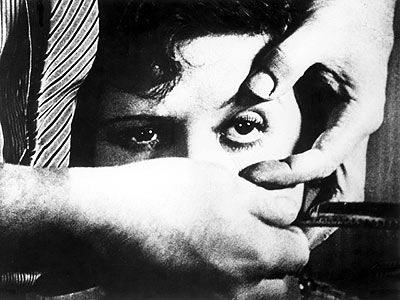
The movie opens with the card “Once upon a time....” We then see a man (Bunuel himself) sharpening a razor blade on a balcony. He looks up and we see a thin cloud approaching a full moon, cut to “wife” (played by Simone Mareuil who later committed self-immolation) being held down by “husband.” The cloud crosses the moon, then we see the razor blade slice “wife's” eye (actually a calf's eye) in half. From then on, to the music of Wagner and a jaunty tango, taunted by ever changing title cards (“About 3 in the Morning,” “17 Years Before,” “In Spring”) we see a man riding a bike down the street in a nun's outfit. We see Dali's dream of an ant-hill hand, then someone run over by a car, then the “wife” being groped by a man drooling blood. We see the “wife” running from the man, then grabbing a tennis racket to defend herself, and the man abruptly stopping to pick up and pull two ropes attached to two ten commandment tablets, two priests (one played by Salvatore Dali), two pianos and two rotting donkey corpses. Later we see a man's mouth replaced by a patch of armpit hair. (I'm giggling just describing the wacky lewdness.)
Call it obscene, disgusting debauchery, but Bunuel's films are a necessary evil. They are the perfect counterbalance to obedient conventional cinema. With his dry humor and weird antics, I adore Bunuel, the wonderful lecher, cheerful and lovable in his eagerness to offend.

Monday, August 17, 2009

Terms of Endearment (1983)


By Eric Jessen 8/17/09

Terms of Endearment is the perfect “spiders stratagem.” It's a well refined lie, a remarkable unprecedented achievement in manipulation. Director James L. Brooks weaves a web of enviable humanity and catches the audience blindsided in a puddle of tears, rubbing their eyes and forced to remark, “I can relate to those characters.” To admit that it is a tearjerker, and worthy of winning best picture, is to acknowledge that it was extremely well executed and has many dupes.
Terms of Endearment pokes and prods at our emotions with calculated precision (Micheal Gore's score assaults our tear ducts relentlessly). It tickles our funny bone with a touch of slapstick: when Shirley MacLaine, as the mid-50's mother, slips and falls while ogling Jack Nicholson, her impressionable neighbor, or when Nicholson's hand gets stuck in MacLaine's bra. It also has quick wit that walks a fine line of biting without leaving teeth marks. But Terms of Endearment mostly relies on humor defined by the characters' persona: MacLaine as Aurora is funny in embarrassment when her childish mom-paranoia and dilapidated overly proper libido are exposed. Nicholson plays Garret Breedlove with non-threatening drunkenness and potbelly charm. Debra Winger, as Aurora's daughter Emma, is endearing with her dorky crackle-laugh and a baby producing machine earthiness. The actors, including Jeff Daniels as Emma's innocent, simple-minded husband, and John Lithgow as a understanding adulterer, all rise above the film's pink gloss. Their wonderful performances make the film watchable for anyone, including non-dupes.
But back to the issue at hand. Terms of Endearment masks itself as honorable, honest, genuine benevolent empathy. It pretends to show “real” people in their true form, encountering love and sadness unexpectedly through life's spontaneity. But the film mistakes the natural unpredictable movement of life for over-eager shabby jumping. It starts with Emma's birth, then leaps to marriage, then to disease, then to death. And the characters, though lovable, reflect an ideal, made for TV bunch. They have only virtues and adorable good hearted faults. We'd all like to believe that our worst quality is that we care too much, or that we're too protective of our children.
James L. Brooks panders to the audience by depicting characters that, no matter what, are innocent, living in the world that's sometimes inexplicably harsh. Nicholson as Breedlove drinks but only enough to bang his head once and act funny. Aurora is stern but not enough to turn any men away. And then all of a sudden there's Emma's cancer. It comes so abruptly and in such an uninspired way, as if to say “Gotcha! See how unpredictable life can be?” I guess I'm supposed to think, “Wow, I hope I'm not taking my loved ones for granted.” But instead I'm thinking, is this all they could think of? It's true, cancer does unexpectedly kill in real life. But in Terms of Endearment James L. Brooks' use of that fact is grotesquely exploitive. He intends to start the waterworks and have word get around, sending flocks of semi-masochistic, stressed women in need of a cry, to the theater.
And yet I'll admit, Terms of Endearment is an effective trick, tolerable for a non-dupe because of its great performances. I'm proud to say I sat through the ending and never shed a tear. Maybe I have a heart that's cold as ice, or perhaps I saw through Terms of Endearment's web of masterful manipulation.

Sunday, August 16, 2009

Diner (1982)


By Eric Jessen 8/15/09

Diner is a lukewarm, humdrum “Happy Days” retread of 1950's nostalgia (a twinkle in the eye, tilted head smile and a depressing sigh included) with cute little bits of the obligatory coffee talk - sports and music, “Sinatra or Mathis?” over a burger and fries and your hot date over apple pie - generic (the eventual sitcom pilot quality) plot devices and reminiscing good old fashioned wholesome guy love.
Diner is set in 1959 Baltimore, where five high school buddies, now in their early twenties, still meet at their favorite diner, sit at their favorite table and eat their favorite dish to forget women, money and adulthood. They bicker and finish each other's thoughts like old married couples, talking about music, movies, and the Colts, recalling the prom and past girlfriends. They cling to their boyishness and boo-hoo their evolving relationships. All five have “growing pains.” Eddie (Steve Guttenberg) is on the verge of marriage but getting cold feet. “Shrevie” (Daniel Stern) is already in the sexless arguing stage of marriage, fighting about how to organize his record collection with his wife (Ellen Barkin). “Boogie,” played with a suave desperation by Mickey Rourke is a hair dresser by day, law student by night and knee-deep in gambling debts. Fenwick, played with inebriated tears of despair by Kevin Bacon, is a whiny failure who “rejected the family business” and is now living on his parents allowance. And Billy, played with muted deadpan personality by Timothy Daly, has impregnated a girl he loves but who doesn't love him.
But as the boys say, “At least we have the diner.” It's their safe haven from the frightening outside world (though we see it as basically harmless), and their uncertain futures. They cherish relaxed guy love at the diner and fear conversations with their wives. They cherish Sweet Smell of Success and fear The Seventh Seal.
Barry Levinson in his directing debut immediately regresses to childhood memory-schmaltz, drifting into his adolescence of growing up in Baltimore, playing sophomoric pranks and watching game shows on a black and white TV. Although Levinson captures the sadness of fading teenage innocence - becoming an adult and feeling uncomfortable and inept cruising for girls or married and bored - behind an uninspired story, lacking snap, crackle or pop, the genuinely amusing dialogue falls flat in the lurking mist of homesick melancholy.