Sunday, July 12, 2009

Bed and Board (1970)


By Eric Jessen 7/11/09

Antoine Doinel, the little ruffian from The 400 Blows, is now grown up. He's settled down, married, not happy but satisfied and no longer running. We all had high hopes for Antoine, he had fire in his eyes, but it turns out he's normal. So normal, that I am somewhat uninterested. This Antoine tries to be witty and has a light hearted personality. But he is whimsical to the point of being annoying. I don't take him seriously. His personality change from The 400 Blows is mainly the result of Jean Pierre Leaud's acting. I called his acting in Stolen Kisses “cute but incredibly flimsy” and it hasn't changed. His air of “I don't care” is supposed to be funny and at times gets a few chuckles but by the end is stale. Antoine and Christine are a darling couple. They're like Anna Karina and Jean-Claude Braily in Godard's A Woman is A Woman. Their shenanigans make me smile, but after one squabble and one silly affair I'm tired of their routine.
In Bed and Board Christine and Antoine are married. Everything is going great. Antoine cheats with a semi racist-stereotype of an Asian woman. (I thought it was stupid, you might think it's funny.) Antoine and Christine separate but Antoine gets sick of the weird Asian stuff, like sitting on mats, so he returns to Christine. That's it.
Bed and Board is dainty and pleasant. If you liked Stolen Kisses, I think you'll enjoy Bed and Board. But if your time is precious, skip it.

Friday, July 10, 2009

Stolen Kisses (1968)


By Eric Jessen 7/10/09

If you watch Stolen Kisses expecting the same Antoine Doinel and the same Jean-Pierre Leaud and even the same Francois Truffaut from The 400 Blows, as I was, you will be sorely disappointed. But let's put that movie behind us, I'll put that disappointing experience behind me. Let's think of this as a new Antoine. Let's step back and judge Stolen Kisses against all other movies we've seen, the trash and the masterpieces. If we do that, than Stolen Kisses is not half bad. If you think of Stolen Kisses as “just another movie” when you enter the theater (that plays old foreign movies, yeah right), or when you pop in the DVD, you might even enjoy it. It can be quite funny. You won't be falling out of your chair or anything, but you might chuckle. I did once or twice. As romantic comedies go, it's cute, but not too cute to make you want to throw up.
In Stolen Kisses Antoine has grown up a little. He's learned the whimsical, foolish lover, routine. We meet Antoine as he's just dropping out of the army. He's thrilled to be back in Paris. The first thing he does is skip to the nearest whore house. He's quite a rascal. He uses his boyish good looks to get several jobs including one working for a private detective agency. Antoine comes across a few women throughout the movie, most notably, Fabienne (Delphine Syrig) who's a sexy middle aged woman, and a previous love Christine (Claude Jade). They run around, and blah blah blah he ends up with the nice one.
There is really not much to tell about Stolen Kisses. It has its funny moments. If you love young people, you'd probably enjoy these kids' charades. Claude Jade's dumbfounded look can be adorable. She looks like a tame version of Catherine Deneuve. And Delphine Syrig is a pleasant surprise. But with Stolen Kisses there is one crucial point I need to make. What happened to Jean-Pierre Leaud? There was so much fire in his eyes in The 400 Blows (sorry to bring that movie up). His so called acting can only be described in this movie as cute but incredibly flimsy. It's impossible to take him seriously. And I know this is not supposed to be a serious movie, but it's like John Stewart or Jimmy Fallen, when they look like they're about to break character any second the act isn't funny. It doesn't allow us to “suspend disbelief.” Jacques Tati as Mr. Hulot, who makes an appearance in another Antoine movie Love on the Run, or Charlie Chaplin put 100 percent effort and seriousness into their comedy. That's why they're so funny. But, oh well, I'll put that behind me too.
So hey, there's this movie by Francois Truffaut staring Jean-Pierre Leaud. He plays a kid named Antoine Doinel, ever heard of him?.... No..... Good, go see it, it's not half bad.

The 400 Blows (1959)


By Eric Jessen 7/9/09

The 400 Blows is one of the extraordinary experiences in film. Watching it is to personally absorb Antoine's suffering. You'll never feel more connected to a character in a movie than with Antoine Doinel (Jean-Pierre Leaud). The 400 Blows revolutionizes the relationship of the movie and its audience. We are no longer detached. The characters are no longer heroes or villains for us to glorify or idealize. There isn't a conventional narrative with a beginning, middle and end, for us to pretend is real and simply go along for the ride. With The 400 Blows we have a more intimate relationship with the movie and the characters. We dive straight into Antoine's life. He is not a hero or a villain but a person that we care for and we see as a part of ourselves, like we would a friend or a loved one. We don't regard his decisions and actions as ones that exist only to move forward a story. Instead they exist as simply a reaction to his life. While watching, we are not waiting for something interesting or important to happen, we are closely following Antoine. We, the audience, exist in the present, in a state of “being” in Antoine's life. I found myself regretting Antoine's mistakes as if I had made them or as if I could have prevented them.
Antoine is an adolescent, probably 14 (Jean-Pierre Leaud's age when he played the part), who attends an all boys school in Paris. He lives at the mercy of many adults who scold him and lecture him but don't care about him. As a result of his childhood of turmoil, he seems unable to care about his own life or other people. He talks with indifference about his mother's contempt for him. He says he lies to his parents because “if I told them the truth they wouldn't believe me anyway.” Antoine still has enough life left in him to run and run and run as much as possible. He tries as often as he can to escape. He seeks independence. Every once in while, when he's failed a school paper, or skipped class, when he has done something to irritate his parents, Antoine flees from home. He wanders around the city. Sometimes he stays at his friends house, but sooner or later when he's out of food he returns home . His life is cold and depressing but he seems to blindly press on.
Jean-Pierre Leaud is brilliant as Antoine. His performance is one of the best by a child actor in movie history. One look at Leaud as Antoine can bring you near tears. You can see in his face and his eyes that his life has destroyed all of his innocence and joy.
John Constantine contributes a moving and memorable score. There are also strong supporting performances by Claire Maurier as Antoine's mother, Alber Remy as his father, Guy Decomble as the School teacher, and Patrick Auffay as Antoine's best friend.
The 400 Blows is a realistic vision of one child's sorrow and hardship. Director Francois Truffaut presents Antoine in such vivid detail that he seems to be Truffaut's childhood persona. The 400 Blows can be sad, but thankfully Truffaut fills us with optimism with an ending that is uplifting. Antoine throughout the movie says he wishes he could see the ocean. Near the end, he is put in a boot camp. He then escapes and reaches the coast. As he approaches the water he slows down in disbelief. He steps into the water, the ocean washes away his problems, and for a moment, for at least a second, Antoine has hope.

Thursday, July 9, 2009

Short Cuts (1993)


By Eric Jessen 7/8/09

In Short Cuts we don't meet just one character, who moves forward a story. There really is no story to tell. We never truly understand any single character's personality. Instead we meet a city, LA, and LA has many characters and all of those character's silly, strange, depressing lives combine to form LA's personality. LA in Short Cuts is a professional phone sex girl, a nightclub singer, a cello prodigy, a pool man, a horror movie makeup artist, a painter of “colorless” naked women, an anchorman, Claire the Clown, a doctor, some housewives, a patrolman, a helicopter pilot, a drunk, a waitress, dozens of ignored children, and much more. They all are intertwined masterfully in Robert Altman's style by small coincidences. And what the people of LA have in common is that they all cheat and lie and are generally unhappy. Some of them are even on the verge of suicide or murder.
Short Cuts is a significant achievement in its ability to weave so many small stories and characters together. Short Cuts paved the way for movies like Crash, Babel and Magnolia. In Short Cuts Robert Altman is trying to accomplish something profound that may have never been tried before in movies. Instead of trying to understand the mind of a single person, the protagonist, he attempts to understand the collective mind of everyone. Maybe he's just trying to understand human nature. In Short Cuts we get the sense that the dozens of characters in LA are all of one conscience. And the final Earthquake, with an apocalyptic message, brings all the characters even closer together. They all experience the same feeling. Instead of indirectly affecting each other, they are all being equally affected by the same thing. With Short Cuts I'm confused but extremely interested.
Short Cuts has the structure but falls short of fully understanding LA. (This is a complicated point, so bear with me.) The point of movies like Short Cuts and Magnolia and even Nashville, in my opinion, is to scratch the surface of many characters, but collectively delve into a broader point. In this case, we don't fully understand any one character, but we are supposed to better understand LA. Altman has effectively shown me that the people in LA lie and cheat. All people in LA are also unhappy, but why? Not, why is each individual happy? I can see why the pool man is unhappy. His wife, the professional phone sex girl, talks dirty in front of their small children. The cello prodigy misses her father, and all the rest are unhappy because they're being cheated on. But why does this happen? What about LA, and what about the world, does this to people? Or, what about people, makes them do this to themselves? Short Cuts has only scratched the surface of it's broader point about LA.
I also think Short Cuts doesn't show the whole picture of LA. I don't live in LA but I know it's not made up exclusively of middle class white people. Where are the poor people, the filthy rich people, the black people, the Asian people, the Hispanic people. Maybe Altman was trying to show us the average person in LA and the US. But how can you understand a city if you've never met entire racial groups and social classes. Either way it's Altman's picture, and he can paint it anyway he wants.
I'll put that issue behind me... Short Cuts is a very entertaining movie. The 187 minutes flew by. I am amazed at Altman's ability to weave together such a large ensemble. The acting is superb, Robert Altman always brings the best out of his actors. In Short Cuts LA is Fred Ward, Andie Macdowell, Bruce Davison, Tim Robbins, Julianne Moore, Matthew Modine, Anne Archer, Jennifer Jason Leigh, Christopher Penn, Lili Taylor, Robert Downey Jr., Madeleine Stowe, Tom Waits, Lily Tomlin, Frances McDormand, Peter Gallagher, Jerrett Lennon, Annie Ross, Lori Singer, Jack Lemmon, Lyle Lovett, Buck Henry, Huey Lewis, and Dirk Blocker.

Wednesday, July 8, 2009

Days of Being Wild (1990)


By Eric Jessen 7/8/09

I wish Wong Kar-Wai would pull the restraints off his tired love stories. His photography is often beautiful. He can make a night time street corner look like a magical dream world. His camera “glides through walls” reminiscent of Max Ophuls. He weaves characters together masterfully. Why is he always peddling lame, “we've been through this a thousand times,” love stories? In Days of Being Wild we're stuck with a rag tag bunch of basket case “young adults.” Too old to be innocent and too young to be wise. They're 18-25 and they're bitter, cynical, mopey, indifferent and then all of a sudden lustful in a period of 90 minutes. They are “wandering,” searching for love or just a one night stand. These are the same people we saw in many of Jean-Luc Godard's movies. Except they aren't fodder for Godard's mocking. Wong Kar-Wai is trying to take them seriously, as if their problems, hardships, and short lived semi-serious desperation is extremely important and interesting.
Our main character in Days of Being Wild is Yuddy, played by famous Chinese actor Leslie Cheung. He's slick, he's smooth, and he knows how to act like he is damaged and needy so he can pick up women. But once he gets them into bed he can't wait to get them out the door. Yuddy tells women he's “a kind of bird with no legs. All it can do is fly and fly. When it gets tired, it sleeps on the wind. This bird can only land once in its whole life. That's the moment it dies.” Later we are told “that bird never actually flew anywhere because it was dead from the very beginning.” That sounds about right. We've come to a realization. The movie is telling us we've been watching dead people the entire time. No wonder I thought all the characters were so bland.
But I will say I find that story catchy and it leads me to an interesting point about Days of Being Wild and all Chinese movies. Watching a Wong Kar-Wai movie can be a frustrating battle of repressed emotions. All the characters look like they are trying to hold everything in and restrain themselves. It is similar to something directed by Robert Bresson (shooting a scene 50 times to strip the emotion from the characters faces). Maybe it's part of Chinese culture and tradition to not show your emotions. But so many times while watching Days of Being Wild and definitely while watching one of Wong Kar-Wai other movies, In the Mood for Love, I wanted someone to scream. The characters with a fire burning inside them, the ones that look like they're going to explode can be interesting. For much of Days of Being Wild I thought Cheung showed some of that interesting quality. But the characters that suppress their motions to the point of seeming dead inside are completely tiring.
There's one thing I always feel after watching a Wong Kar-Wai movie. I'm always left wanting more. Because, with all of his talent and skill, I still am willing to wait for the moment the story gets interesting and the emotions gets ramped up and he reaches magnificence.

Branded to Kill (1967)


By Eric Jessen 7/7/09

Branded to Kill is a jumbled mess of originality. There is an incomprehensible story, one ridiculous killing after another, naked women everywhere, and a camera that jumps from one strange sometimes awkward but sometimes brilliant angle to the next. It's like Jean-Pierre Melville's Le Samurai or Goldfinger or one of John Woo's better movies gone totally insane and out of control. But of course, I thought it was fantastic. Yes it needs some tidying up (or maybe that would ruin it), but I must commend director Seijun Sezuki for making a movie that jumps out of the screen. It pops. It still today, 42 years later, seems inventive and radical. I thank Sezuki for influencing directors like John Woo and Quentin Tarantino. What would we do without creative violence in movies like when “killer No. 3”, our protagonist assassin, kills one of his targets from a basement by shooting up a sink pipe? How can I forget a hilariously ridiculous scene when two killers hug, then both shoot each other simultaneously in the gut, one falls to the floor, then the other executes him, flips his jacket over his shoulder, saunters away and then collapses, but just before he dies pulls his jacket over his head?
Branded to Kill is in every way absurd, and yet very exciting. Some scenes look blatantly fake and cheap, while others are handled with great directorial precision. The first half looks like a mash up of a low budget original and a well funded remake. Speaking of the first half, it was totally bewildering. The killings come so fast. Then “Killer No. 3” is in his house with his wife and she's running around naked screaming “Horny!”(She was never not naked.) Then they're having sex on a spiral staircase (which just looked uncomfortable) and then all of a sudden she is trying to kill him. Finally the wife did some explaining, and I came to my senses. The killings were all part of killer 3's assignment, and he learned the purpose from his wife just as we did. It was all because of some diamond smuggling stuff, which doesn't even matter. I realized that, of course, assassins wouldn't find out why they are killing. Their life is just one brutal killing after another with some meaningless sex in between. If they ever found out why they were killing they would be liable to squeal. (By the way, the wife turns out to be a spy, so Killer 3 kills her by shooting her in her naughty parts.)
I started looking at Branded to Kill in a different way. It's actually quite smart. It's not just exploitive of violence and naked women. Sizuki knows what he's doing. There is a thematic method to his madness. He is studying the mind of the killer. As in Le Samurai and in John Woo's The Killer.
After the wife's explanation I was in for more bewilderment. But I guess that's this movie's charm. Killer 3 falls in love. We know this because he sees butterflies (literally), with a woman named Misako. He is supposed to kill Misako but can't. Misako understands their situation perfectly. Killer 3 threatens “I can kill you with one shot” and then Misako replies “you won't until you sleep with me.” Later Misako is killed by strange men, or so it seems. Killer 3 tries to revenge her death, but then somehow gets tangled up with the mysterious “Killer No. 1” (there are many numbered killers, 1 being the best). The movie ends with a show down in a dark gymnasium where, go figure, everyone dies.
Some people may hate Branded to Kill because it doesn't really have a story and can be confusing, but that doesn't mean it is not worth seeing . Just sit back and enjoy the creativity. A beautifully weird killing can be a work of art. And a movie like Branded to Kill can be a jumbled mess of brilliance.

Tuesday, July 7, 2009

Eastern Promises (2007)


By Eric Jessen 7/7/09

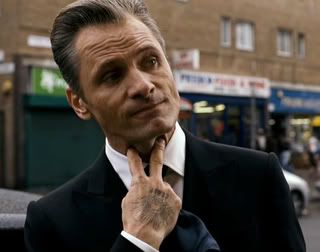
Suspense builds beneath the surface even with the occasional sudden eruption of savage violence. Viggo Mortensen as Nikolai struts and shrugs and nods his head with a sadistic nonchalance. David Cronenberg is not as creative as in Vidiodrome or Crash, more traditional, but also more stylish, more calm and more likable for the modern audience. The stylishness is mostly thanks to Mortensen. Many wouldn't call Eastern Promises or his recent History of Violence calm because the bloodshed can be hard to stomach. But Cronenberg's recent movies are calm because they deal with realistic characters and subjects.
The subject in this case is the Russian Mafia in London. A Mafia that is new and sexy. The strange foreign language is fresh. The tattoos that mark their deathly accomplishments are twisted yet glamorous. We're all tired of the Italian Mafia anyway. Some of the new Mafia's style we are familiar with like the greased up hair, the so called language of subtleties (secret code like “the coast is clear,” plus nods, winks...), along with the low brow manipulation and ruthlessness. The central characters are actually somewhat boring on the surface. There is a half Russian half British midwife Anna(Naomi Watts) who “just cares about the baby,” poor and helpless as it is, that was left behind by a dead Mafia prostitute. And there is also a Mafia chauffeur Nikolai (Viggo Mortensen) who has some other yucky jobs as well. The characters are only interesting because of Mortensen's and Watts' brilliant acting. There is something deliciously evil about Mortensen's appearance and demeanor. But at the same time, when it comes to women, of course he's capable of humility. As for Watts, she just seems down right exhausted with everything. It gives her character a feeling of desperation, like she is unbelievably needy. She is helping an orphan baby, but she needs it as much as it needs her. She can't be in her right mind when she is dealing with the Mafia. She is supposed to be just “an ordinary person,” doesn't she know the Mafia is dangerous?
Part of me wishes David Cronenberg was still making insanely creative and inventive movies. And I know they aren't as lucrative, but there are not enough movies like that being made today. But oh well, these movies are fun. I love it when movies can accentuate the coolness of evil characters, as sick as that may sound. Plus, I was totally immersed in the story.
My only problem with this movie is that, go figure, Mortensen turns out to be a good guy all along. He played the seductive villain perfectly, why does he need to turn out to be good? At least, in the end, it's not like he's Mister Rogers good, he's still pretty bad. You have to be a little perverted to be an undercover rat.
Eastern Promises is a little good, a little bad, a little crazy, mostly realistic, always stylish and always fun.